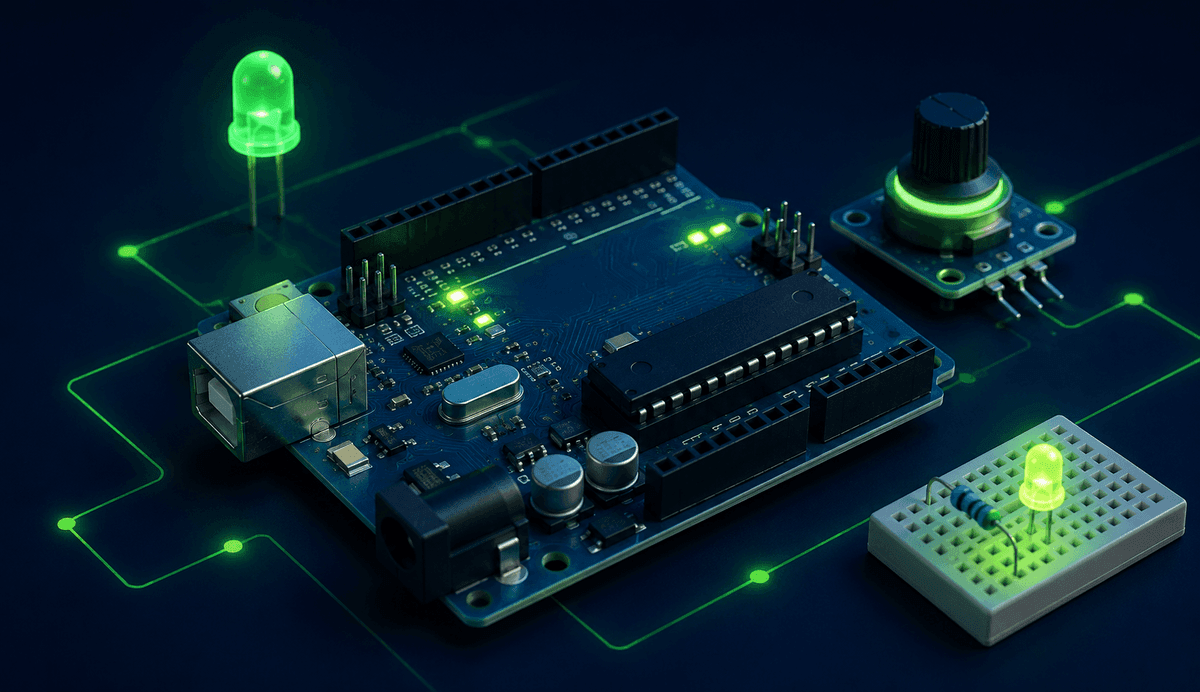
What is Arduino? A Comprehensive Guide for Beginners.

 06.16.2026
Arduino is an open-source hardware and software platform that makes it easy to develop electronic projects. This article explains in detail what Arduino is, how it works, and why it is ideal for beginners. It also covers its basic use cases.
What is Arduino?
Arduino is a microcontroller-based development platform. It enables the creation of a wide range of projects, from simple electronic circuits to smart systems. It includes both hardware and software components and is supported by a large open-source community.
Its beginner-friendly design makes it especially popular in education and hobby projects.
- It is an open-source electronics platform.
- It includes microcontroller boards and a software environment.
- It allows hardware control with simple code.
- It has strong community support.
How Does Arduino Work?
Arduino works by uploading code written on a computer to a microcontroller board. This code can read data from sensors and control components such as motors and LEDs. It is mainly based on input and output logic.
The system runs in real time and continuously executes commands in a loop. This structure is especially suitable for automation projects.
- Code is uploaded from a computer to the Arduino board.
- Data can be received from sensors.
- Output components can be controlled.
- It operates in a continuous loop structure.
What Can Be Done with Arduino?
Arduino has a very wide range of applications. It can be used for everything from simple LED projects to smart home systems. Its flexible structure makes it ideal for both education and prototyping.
This variety makes learning Arduino both fun and educational.
- LED and button-based circuits can be built.
- Robotics projects can be developed.
- Smart home automation systems can be created.
- Sensor-based measurement devices can be designed.
- IoT (Internet of Things) projects can be built.
Is Arduino Hard to Learn?
Arduino is quite easy to learn, especially at the beginner level. Thanks to its visual and hands-on nature, users can quickly see results. This increases motivation and speeds up the learning process.
However, for more complex projects, knowledge of electronics and programming should be gradually improved.
- Suitable for beginners.
- Provides quick visual feedback.
- Basic electronics knowledge is sufficient.
- Advanced projects are learned over time.
What Basic Components Are Needed for Arduino?
Arduino projects use some basic hardware components. These parts enable the circuit to function and allow different types of projects to be built. A basic starter kit is enough for beginners.
These components are standard in most entry-level projects.
- Arduino UNO board
- Breadboard
- LED lights
- Resistors
- Jumper wires
- Sensor modules
Arduino and Programming Language
Arduino uses a simplified version of a C/C++-based programming language. This language is designed to be easy to learn. Hardware control can be done with basic commands.
Because the coding logic is simple, beginners can quickly start developing projects.
- Based on C/C++ structure
- Contains simplified commands
- Allows easy hardware control
- Enables fast learning
Why is Arduino Ideal for Beginners?
Arduino is a powerful tool for beginners because it teaches both software and hardware together. Users learn not only how to code but also how electronics work.
Its fast feedback system makes the learning process more efficient and keeps users motivated.
- Teaches coding and electronics together
- Allows starting with simple projects
- Provides instant results
- Makes learning process enjoyable
Arduino offers an educational and engaging starting point for beginners. By teaching basic electronics and coding concepts together, it builds a strong foundation. With regular practice, it is possible to move on to more advanced and complex projects.