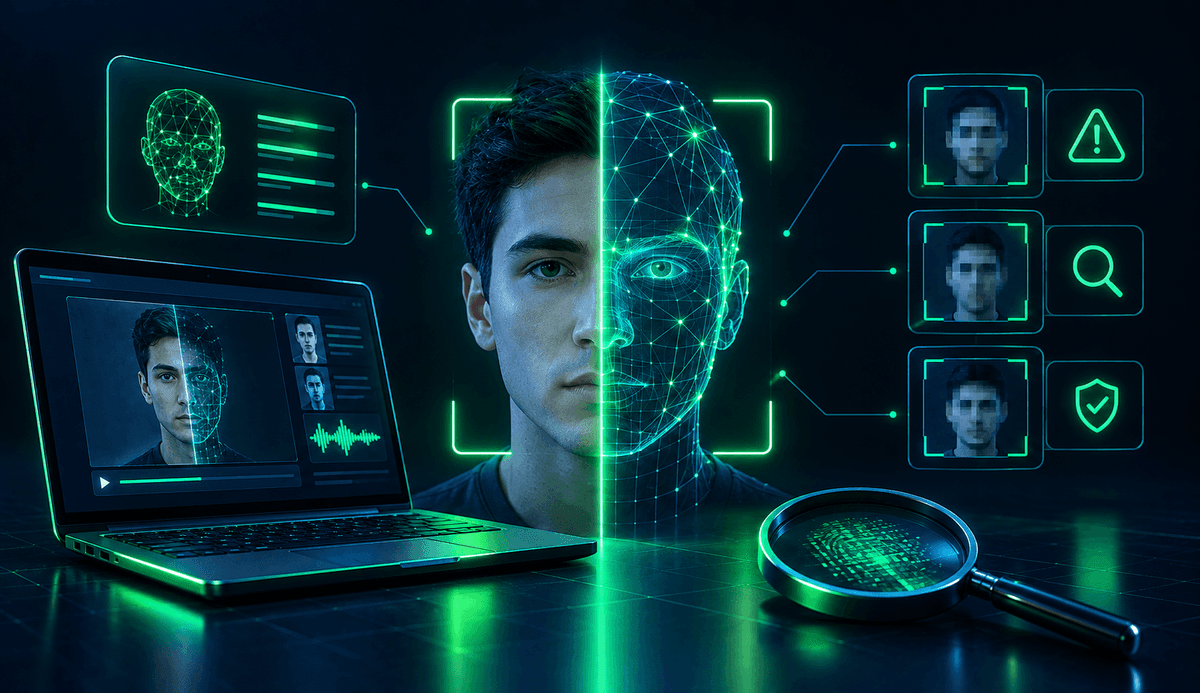
What is Deepfake? How to Detect It, and What to Watch Out For?

 09.07.2026
Deepfake technology uses artificial intelligence to create fake images, audio, and videos that look and sound remarkably real. In this article, you'll learn how deepfake technology works, how to detect deepfake content, and what to keep in mind to stay safe in the digital world.
What Is a Deepfake?
A deepfake is realistic digital content created using artificial intelligence and deep learning technologies. With this technology, a person's face, voice, or facial expressions can be transferred to another image or video in a highly realistic way.
Originally developed for entertainment and content creation, deepfake technology is now used in various fields, including education, film, and digital media. However, it is also a technology that requires caution due to the potential for malicious use.
How Does Deepfake Technology Work?
Deepfake systems analyze large amounts of images, videos, or audio recordings to learn a person's facial expressions, speaking patterns, and mannerisms. This data is then used to generate new content that closely resembles reality.
The artificial intelligence models used in this process can continuously learn and produce increasingly natural results. As a result, some deepfake content can be very difficult to distinguish from authentic content at first glance.
Where Is Deepfake Technology Used?
Deepfake technology is not used solely for malicious purposes. When used correctly and ethically, it can provide useful solutions across many industries.
Some of its main applications include:
- Film and television productions
- Advertising and digital marketing
- Educational content
- Game development
- Language dubbing and voice adaptation projects
- Digital recreations of historical figures
How Can Deepfakes Be Detected?
Although deepfake technology continues to improve, certain signs may still become noticeable when content is examined carefully. No single indicator can provide a definitive answer, but considering multiple clues together can make it easier to identify suspicious content.
Some of the key things to look for include:
- A mismatch between lip movements and audio
- Unnatural-looking blinking patterns
- Inconsistencies in lighting and shadows
- Blurring or distortion around the edges of the face
- Visual inconsistencies between the person and the background
- Artificial or mechanical transitions in the voice
What Signs Should You Look for in Deepfake Videos?
Although visual quality continues to improve as the technology advances, certain details can still provide important clues. Paying close attention to the consistency between facial movements and surrounding elements can make it easier to identify manipulated content.
When watching a video, it's useful to look beyond the person's face. Pay attention to neck movements, the hairline, the area around the eyes, and objects in the background. Sudden visual changes or unnatural transitions may be signs that the content has been manipulated.
How Can Deepfake Audio Recordings Be Identified?
AI models used for voice generation can produce highly convincing results. However, some recordings may still display characteristics that differ from natural speech when listened to carefully.
For example, weak emotional variation, unusual emphasis, or unnatural pauses may be noticeable during speech. When dealing with audio recordings that contain important information, verifying the information through another reliable source is always a safer approach.
What Should You Do When You Encounter Deepfake Content?
Not everything you see on the internet is necessarily accurate. Verifying the authenticity of particularly striking videos or audio recordings can help prevent the spread of misinformation.
If you encounter suspicious content, consider taking the following steps:
- Examine the source where the content was published
- Check whether reliable news sources have reported the same event
- Investigate how the image or video has been shared across different platforms
- Avoid sharing content hastily
- Do not assume that unverified content is authentic
What Should Companies Do to Address Deepfake Risks?
Deepfake technology can affect not only individuals but also organizations. Raising employee awareness of this technology is important for corporate communications, brand reputation, and digital security.
Companies can take several precautions, including:
- Providing employees with digital awareness training
- Establishing corporate verification procedures
- Clearly communicating official communication channels
- Developing verification mechanisms for suspicious media content
- Regularly updating AI usage policies
How Is the Future of Deepfake Technology Evolving?
As artificial intelligence technologies advance, deepfake tools are also becoming capable of producing increasingly realistic results. At the same time, new systems for detecting and analyzing manipulated content are being developed.
In the future, the wider adoption of content verification technologies and improvements in digital literacy could help reduce the risks associated with deepfakes. For this reason, it is important for both individuals and organizations to closely follow developments in this technology.
What Is the Relationship Between Deepfake and Artificial Intelligence?
Deepfake is one of the applications of artificial intelligence. In particular, deep learning algorithms make it possible to generate and manipulate images and audio. However, artificial intelligence encompasses a much broader technological field and is used for various purposes across industries such as data analysis, automation, healthcare, education, and software development.
Deepfake technology is one of the most notable applications of artificial intelligence. As digital content becomes increasingly realistic, checking reliable sources, verifying content, and developing digital awareness are becoming increasingly important for both individuals and organizations.