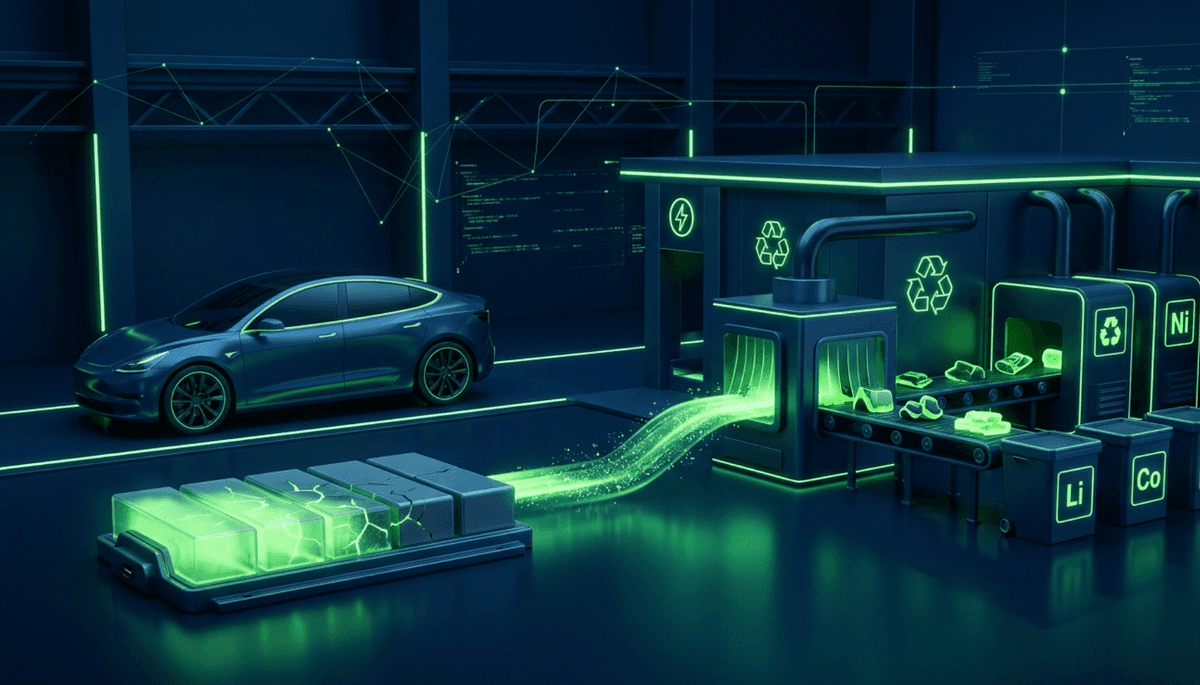
Electric Vehicles: What Really Happens When the Battery Dies?

 31.08.2026
One of the biggest questions in the minds of those considering buying an electric vehicle (EV) is the future of the vehicle's battery. Questions such as "How many years does an EV battery last?", "Does the car become unusable when the battery ages?", "Is battery replacement necessary?", and "Are degraded batteries simply thrown into the trash?" are gaining critical importance as EV technology expands.
However, there is no single answer to these questions. Explaining an EV battery's lifespan solely through elapsed calendar years is impossible. Factors like battery chemistry, operating conditions, temperature, charging habits, and driving style all impact battery performance over time.
Furthermore, the end of a battery's initial use in an automobile does not mean it becomes completely useless.
How Long Does an EV Battery Actually Last?
One of the most common claims regarding electric vehicles is that batteries have a lifespan of around "8 to 10 years." However, treating this figure like an absolute expiration date is inaccurate.
Lithium-ion batteries lose capacity over time as they age and undergo charge cycles. Consequently, a battery delivering a specific range in a brand-new car may not store the same amount of energy years later. Crucially, this does not mean the battery will abruptly stop working after a set number of years.
Real-world data shows that total EV operational lifespans can be longer than widely believed. A comprehensive study published in Nature Energy estimated the average lifespan of battery electric vehicles to be 18.4 years. It must be emphasized that this figure refers to the overall vehicle lifespan, not that the battery maintains 100% capacity for 18.4 years.
Rather than making definitive claims like "the battery dies after 10 years," it is more accurate to state that the battery gradually loses capacity throughout its operational life.
A Dropped Capacity Does Not Make the Car Scrap!
When an EV battery loses capacity over time, the vehicle does not automatically become unusable.
While a new car offers a higher range, degradation reduces that total distance over time, which may be felt primarily during long-distance highway driving. However, usable capacity still remains.
The key takeaway is this: A battery no longer optimal for automotive performance can still serve other applications. This approach is known as "second life."
Can Old EV Batteries Be Used for Energy Storage?
In many cases, yes.
Batteries deemed insufficient for vehicles due to strict range and performance demands can be repurposed into stationary energy storage systems under appropriate conditions. Examples include storing energy generated from renewable sources or supporting utility grid stability.
The International Energy Agency (IEA) highlights that batteries retired from automotive use can find a second life in stationary storage.
However, an important nuance remains: not every used EV battery is suitable for a second life. Factors such as state of health (SoH), safety parameters, remaining useful life, disassembly and re-installation costs, and the falling prices of brand-new batteries heavily influence this decision.
According to IEA evaluations, key challenges facing second-life applications include safety and warranty requirements, uncertainties regarding remaining lifespan, repurposing costs, and cost reductions in new battery manufacturing. Therefore, assuming "every old battery will be reused" is inaccurate.
What Happens When a Battery Can No Longer Be Used at All?
This is where recycling enters the picture.
Depending on their specific chemistry, EV batteries contain lithium, nickel, cobalt, copper, aluminum, graphite, and other materials. At the end of a battery's life cycle, the objective is to recover these materials and reintroduce them into the economic value chain.
The lifecycle of an EV battery should not be viewed as a simple "replace and discard" sequence. A proper framework flows as follows:
Automotive Use $\rightarrow$ Evaluation $\rightarrow$ Second Life (if feasible) $\rightarrow$ Recycling $\rightarrow$ Material Recovery & Reuse
The efficiency of this loop depends on the battery chemistry, recycling technology advancement, economic feasibility, and regional infrastructure.
Recycling Recovers Valuable Raw Materials
A primary driver of battery recycling is the recovery of critical raw materials. As global EV adoption scales, raw material demand increases proportionally. Recycling end-of-life batteries will become a vital pillar of the material supply chain.
The IEA emphasizes the importance of recycling for recovering materials like lithium, nickel, cobalt, and copper. However, current recycling capacities cannot fully meet the total demand for new raw materials on their own. Recycling is not a silver-bullet solution, but it forms an essential component of a circular battery economy.
What Happens When Millions of EVs Age?
This question will become increasingly prominent in the coming years due to accelerating EV adoption. IEA data shows global electric car sales exceeded 20 million units in 2025, growing approximately 20% year-over-year.
Batteries sold today will remain in service for years. Consequently, the volume of batteries reaching second-life and recycling channels will grow substantially.
A critical distinction must be maintained: the end of a vehicle's primary ownership is not the end of the battery's life. When an EV is sold on the secondary market, the battery remains in active service. Therefore, an increase in EV adoption does not translate to an immediate surge in recycled batteries.
Why Battery Health Matters When Buying an EV
When purchasing an EV, particularly on the pre-owned market, evaluating how battery health is measured is as vital as looking at raw capacity.
This brings forward the concept of State of Health (SoH). SoH measures a battery's current condition relative to its original manufactured state. Because manufacturers utilize different diagnostic metrics, relying solely on a single percentage readout may not provide a complete picture of future performance.
Standardized measurement methods remain an evolving area in the automotive industry. A study published in Nature highlighted the need for uniform diagnostic standards across the sector.
Prospective buyers of used EVs should look beyond the instrument cluster's range display and request official technical health reports and service records.
What Causes EV Battery Degradation?
Battery aging is driven by multiple factors, including:
- Operating and ambient temperatures
- Charge and discharge dynamics (C-rates)
- Prolonged exposure to extreme states of charge (0% or 100%)
- Usage intensity and driving habits
- Battery Management System (BMS) software optimization
Because of these variables, two identical EV models may exhibit different degradation curves over time. Advanced cell chemistries and updated BMS technology continue to improve longevity and resilience.
When purchasing an EV, rather than asking "How many years will it last?", buyers should evaluate:
- 1. What is the duration and coverage of the battery warranty?
- 2. How does the manufacturer define actionable capacity loss under warranty?
- 3. How is battery health measured and certified?
Why is the EU Regulating Battery Lifecycles?
As EV adoption grows, environmental and regulatory focus extends beyond vehicle usage to encompass the entire lifecycle—from raw material extraction to final recycling.
The European Union's Batteries Regulation establishes frameworks governing sustainability, collection targets, repurposing protocols, and material recovery targets.
A major milestone of this framework is the Digital Battery Passport, mandated for specific EV batteries starting February 18, 2027. This digital record tracks lifecycle data, supply chain transparency, health metrics, and recycled content percentages.
Are EV Batteries Completely Impact-Free Environmentally?
No. Battery production—from raw material extraction through cell manufacturing—carries environmental footprints. Logistics, disassembly, second-life conversion, and recycling also require energy inputs.
However, this does not mean batteries become unmanaged waste at end-of-life. Lifecycle assessment (LCA) analyses by the IEA indicate that while battery production emissions must be mitigated, electric vehicles generally yield lower net lifecycle emissions compared to internal combustion engine (ICE) vehicles, depending on the grid's energy mix.
6 Essential Battery Takeaways for EV Buyers
1 No Sudden Expiration
Capacity degrades gradually over time rather than failing abruptly at a fixed year mark.
2 Reduced Capacity $\neq$ Scrapped Car
A lower battery capacity simply means reduced range, but the vehicle remains functional.
3 Second-Life Potential
Retired vehicle batteries can be repurposed for stationary grid and renewable energy storage.
4 Selective Suitability
Second-life repurposing depends on SoH, safety standards, and economic viability.
5 Recycling Recovers Value
End-of-life recycling recovers critical materials like lithium, nickel, and cobalt.
6 Review Warranty Terms
Examine manufacturer warranty durations alongside defined capacity loss thresholds.
The Future of Electric Vehicles: Beyond Just Battery Lifespan
Concerns regarding battery degradation are understandable given that the battery is the single most valuable component of an EV. However, the idea that an aged battery turns an entire car into scrap is inaccurate.
As battery technology, diagnostic standards, recycling infrastructure, and regulatory frameworks mature, an EV battery's story does not end when its initial automotive use concludes.
In the future, retired EV batteries will serve as secondary energy assets and critical material reservoirs for the circular economy. Realizing this potential depends not only on battery engineering itself, but also on global recycling capacity, safety compliance standards, repurposing economics, and regional infrastructure development.