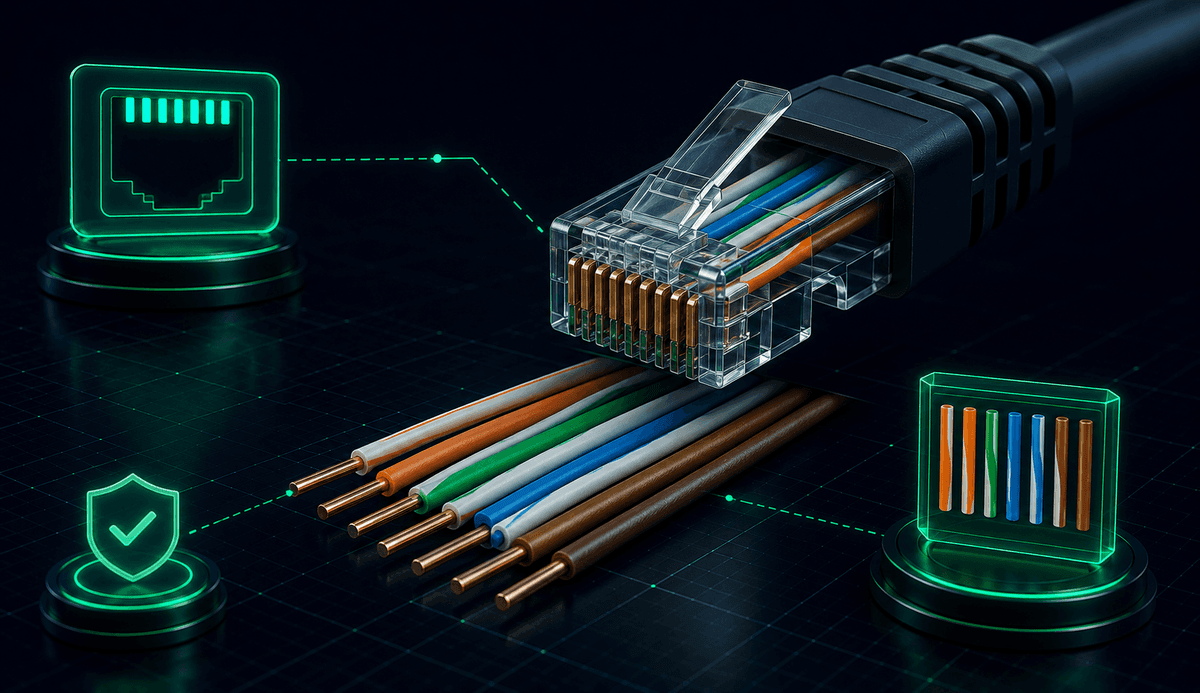
What are the colors of Ethernet cables? Why is their order important?

 07.14.2026
The Ethernet cable color order is essential for ensuring reliable data communication between computers, modems, routers, switches, and other network devices. In this guide, you'll learn what the Ethernet cable colors represent, the differences between the T568A and T568B wiring standards, their color sequences, and why following the correct order is important.
What is an Ethernet cable?
An Ethernet cable is a physical networking cable that connects devices within a wired network. It is commonly used in home networks, offices, and enterprise environments.
Rather than transmitting electrical power, Ethernet cables carry data packets between computers, modems, switches, routers, and other networking equipment. Today, Cat5e, Cat6, Cat6A, and Cat7 are among the most commonly used Ethernet cable categories.
What do Ethernet cable colors represent?
An Ethernet cable contains eight individual conductors organized into four twisted pairs. Each wire is identified by a specific color according to international wiring standards.
The standard Ethernet cable wire colors are:
- White/Orange
- Orange
- White/Green
- Blue
- White/Blue
- Green
- White/Brown
- Brown
These color codes not only make the wires easier to identify but also ensure that cables are terminated according to internationally recognized standards.
Why is the Ethernet cable color order important?
Connecting the wires in the correct sequence is critical for maintaining a stable and reliable network connection. Incorrect wiring can cause connectivity problems, signal degradation, or unstable data transmission.
Using the correct color order provides several benefits:
- Reliable data transmission
- Stable network connectivity
- Reduced signal loss
- Standards-compliant wiring
- Better compatibility between networking devices
- Easier maintenance and troubleshooting
For these reasons, it is important to follow the appropriate wiring standard when terminating Ethernet cables.
What are the T568A and T568B standards?
The two most widely used Ethernet wiring standards are T568A and T568B. Both comply with international structured cabling standards.
The primary difference between them is the position of the green and orange wire pairs. Although T568B is more commonly used in modern residential and commercial networks, T568A is equally valid and standards-compliant.
What is the T568A color order?
The T568A standard is commonly used in certain enterprise environments and structured cabling installations. When both ends of the cable use the same standard, the result is a straight-through cable.
The T568A pinout is:
- White/Green
- Green
- White/Orange
- Blue
- White/Blue
- Orange
- White/Brown
- Brown
Applying the same sequence at both ends ensures proper network communication.
What is the T568B color order?
T568B is the most widely used Ethernet wiring standard today and is commonly found in home and office networks.
The T568B pinout is:
- White/Orange
- Orange
- White/Green
- Blue
- White/Blue
- Green
- White/Brown
- Brown
Like T568A, the T568B standard fully complies with international Ethernet cabling specifications.
What's the difference between straight-through and crossover cables?
Ethernet cables can be terminated as either straight-through or crossover cables, depending on their intended purpose. Although most modern networking devices support automatic crossover detection (Auto MDI-X), understanding the difference is still useful.
The key differences are:
- Straight-through cables use the same wiring standard on both ends.
- Crossover cables use T568A on one end and T568B on the other.
- Straight-through cables are commonly used to connect computers, routers, switches, and modems.
- Crossover cables were traditionally used to connect similar devices directly.
Today, most networking equipment automatically detects the cable type, making crossover cables less common than in the past.
What should you consider when making an Ethernet cable?
In addition to following the correct color sequence, proper cable termination is essential for a reliable connection. Poor crimping or incorrectly aligned wires can lead to connectivity issues.
When terminating an Ethernet cable, remember to:
- Choose the appropriate wiring standard.
- Do not alter the wire color sequence.
- Align the wires carefully.
- Insert the RJ45 connector correctly.
- Use a proper crimping tool.
- Test the completed cable with a cable tester.
These steps help create more reliable and longer-lasting network connections.
What happens if the Ethernet cable color order is incorrect?
An incorrect wire sequence can prevent the network connection from working properly or cause intermittent connectivity issues. It may also reduce network performance.
Common problems include:
- Failure to establish a network connection
- Slow data transfer speeds
- Packet loss
- Frequent connection drops
- Network devices failing to communicate with each other
For this reason, it's recommended to test every cable after termination.
Why shouldn't Ethernet cable color standards be changed?
Ethernet color standards were developed to establish a universal wiring system used worldwide. Following these standards ensures compatibility between networking equipment from different manufacturers.
Standardized wiring also simplifies maintenance and troubleshooting while making it easier to expand or upgrade existing network infrastructure in the future.
Conclusion
The Ethernet cable color order is one of the most important factors in ensuring stable and reliable network communication. Understanding the T568A and T568B standards, following the correct wiring sequence, and testing completed cables can help you build a dependable networking infrastructure for both home and business environments.