Small Language Models (SLM) vs. Large Language Models: What are the Differences?

 09.08.2026
Language models used in artificial intelligence applications can be developed in different sizes depending on the needs of the application. Small Language Models (SLMs) require fewer resources, while Large Language Models (LLMs) stand out for their ability to handle a wide range of tasks. In this article, we’ll explore the key differences between SLMs and LLMs and examine their common use cases.
What Is a Small Language Model (SLM)?
A Small Language Model (SLM) is a language model designed to use fewer parameters and computational resources. Parameters are mathematical values that a model learns from data and uses to make predictions.
SLMs are generally developed to provide high efficiency for specific tasks. Thanks to their smaller size, they can be easier to deploy on devices with limited hardware capabilities or within specialized applications.
For example, if a company wants to develop an AI system solely for classifying customer messages, it may not need a very large model. An SLM designed for this specific task may meet the requirement while using fewer computational resources.
What Is a Large Language Model (LLM)?
A Large Language Model (LLM) is an AI model trained on very large datasets and capable of performing a broad range of language-related tasks. It can be used for tasks such as text generation, summarization, translation, question answering, and code generation.
LLMs can contain a large number of parameters. This larger architecture supports their ability to handle different tasks and understand more complex textual contexts.
Today, LLM technology is used in many applications, including chatbots, coding assistants, and content generation tools.
What Are the Key Differences Between SLMs and LLMs?
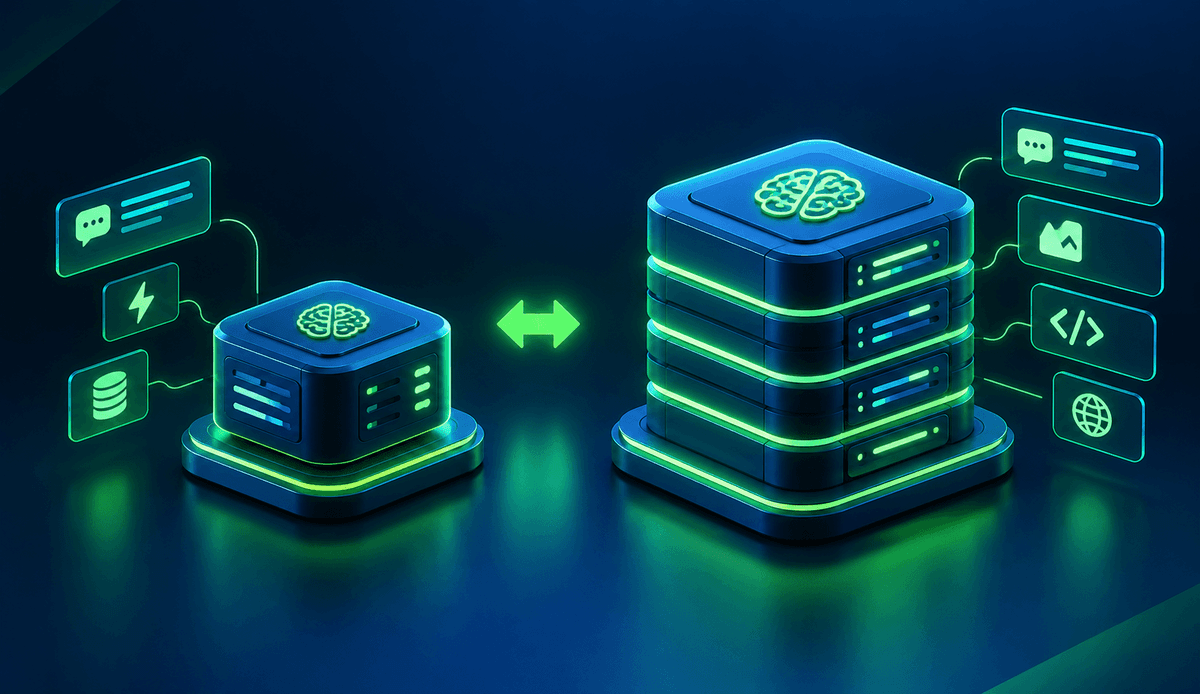
The most obvious difference between SLMs and LLMs is their size. However, model size can also affect several other factors, including performance, cost, speed, and potential use cases.
The key differences can be summarized as follows:
- Model size: SLMs have smaller architectures, while LLMs are significantly larger.
- Resource requirements: SLMs generally require less computing power and memory.
- Speed: Smaller models can provide faster responses for suitable tasks.
- Task scope: LLMs can offer advantages when handling broader and more complex tasks.
- Deployment environment: SLMs can be better suited for on-device applications.
- Cost: Lower resource requirements can reduce the operational cost of using SLMs.
These differences do not apply equally to every model. Factors such as model architecture, training methods, and the specific use case can directly affect the results.
How Do SLMs and LLMs Compare in Terms of Performance?
A model's performance should not be evaluated solely based on its number of parameters. The task the model was designed for is also a critical factor.
SLMs can deliver highly effective results when they are optimized for a specific task. LLMs, on the other hand, can provide broader capabilities for switching between different tasks and handling more complex contexts.
Therefore, an SLM may be sufficient for an application designed to perform a simple and specific task, while an LLM may be more suitable for an application that needs to perform multiple tasks within the same system.
How Do SLMs and LLMs Differ in Resource Usage?
Language models require resources such as computing power, memory, and storage to operate. As the size of a model increases, these requirements generally increase as well.
Thanks to their smaller architecture, SLMs can be deployed on devices with more limited hardware capabilities. This can make it easier to run AI applications on computers, smartphones, and other edge devices.
LLMs, on the other hand, may require greater computational capacity. Running and scaling large models can therefore require more powerful infrastructure.
What Are the Use Cases of SLMs and LLMs?
Both types of models can be considered for different needs. The key is to focus on the requirements of the application rather than simply choosing a model based on its size.
SLM use cases:
- Text classification
- Simple question-answering systems
- On-device AI applications
- Domain-specific text processing
- Command and intent detection
LLM use cases:
- General-purpose conversational assistants
- Content generation
- Code generation and explanation
- Long-form text summarization
- Multi-step text-based tasks
These use cases are not strict boundaries. Depending on the model and the requirements of the application, both SLMs and LLMs can be used for a variety of tasks.
Can SLMs Run on Devices?
One of the key characteristics of SLMs is that, when properly optimized, they can be well suited for running on edge devices. An edge device refers to a computer, smartphone, or similar system where data is processed locally instead of being sent to a remote server.
This approach can reduce connectivity requirements and, in some scenarios, allow certain data to remain on the device. However, whether a specific model can run on a device depends on the device's hardware capabilities and the model's level of optimization.
How Do SLMs and LLMs Differ in Terms of Data Privacy?
Data privacy is just as important as model size when developing AI applications. Especially in systems that process user data, organizations need to carefully consider where data is processed and how it is protected.
SLMs that can run on devices may, in certain scenarios, allow data to be processed locally without sending it to a remote server. However, this does not automatically mean that SLMs are more secure. Security should be evaluated holistically, taking into account the model, application, data processing methods, and underlying infrastructure.
Should You Choose an SLM or an LLM?
The right model should be selected based on the requirements of the project. A larger model is not always the better option.
When selecting a model, consider questions such as:
- What task will the application perform?
- How much computational power is available?
- Will the model run on a device?
- How important is response speed?
- Does the model need to perform multiple tasks?
- How will the data be processed?
- Will the model need to be scaled?
For projects that need to perform a specific task quickly and efficiently, an SLM can be a suitable option. For broader and more complex tasks, an LLM may be more appropriate.
Will SLMs Replace LLMs?
Rather than viewing SLMs and LLMs as direct alternatives, it is more accurate to consider them as technologies designed to address different needs. Both types of models have areas where they perform particularly well.
The increasing adoption of AI on devices, along with growing demands for lower costs and faster responses, may drive greater adoption of SLMs. At the same time, the capabilities offered by LLMs will remain important for broad and complex AI applications.
The choice between an SLM and an LLM depends less on the size of the model and more on the requirements of the project. SLMs can offer advantages in terms of speed, resource efficiency, and on-device deployment. LLMs, meanwhile, stand out when a broader range of tasks and more complex processing capabilities are required.