Differences Between Machine Learning and Deep Learning

 09.29.2026
Machine learning and deep learning are two commonly used concepts in the field of artificial intelligence. Although they are related to each other, they differ in terms of how they work and where they are used. In this guide, we will explore what machine learning and deep learning are, their key differences, and the situations in which they are used.
What Is Machine Learning?
Machine learning is an artificial intelligence approach that enables computers to learn patterns from data without requiring every rule to be explicitly defined. By learning certain relationships from historical data, a system can make predictions or classifications about new data.
For example, a machine learning model that analyzes historical customer data can be used to predict which products customers with certain characteristics may be interested in.
The method used in machine learning may vary depending on the type of problem and the structure of the data. Therefore, the same algorithm does not have to be used in every machine learning project.
What Is Deep Learning?
Deep learning is a subfield of machine learning. It focuses on learning more complex relationships within data by using multilayer artificial neural networks.
Artificial neural networks are mathematical structures inspired by the learning processes of the human brain. Using multiple layers in deep learning allows systems to learn different features in data progressively.
Deep learning methods can be particularly useful when working with complex types of data such as images, audio, and natural language.
What Is the Difference Between Machine Learning and Deep Learning?
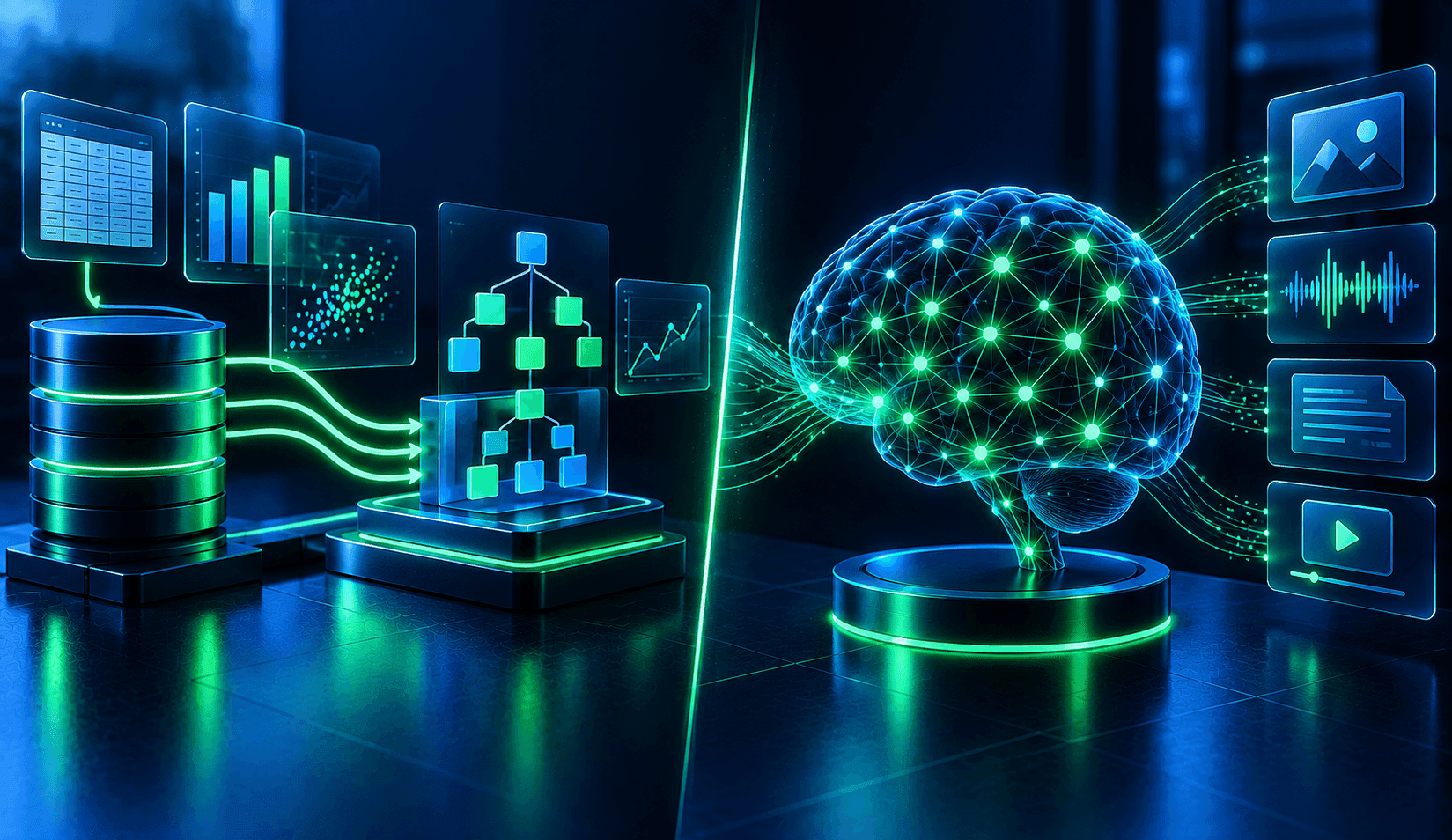
The fundamental difference between machine learning and deep learning lies in how data is processed and how features are learned. In traditional machine learning methods, identifying and preparing the features to be used is often an important step.
Deep learning models, when provided with suitable data and model architectures, can learn features directly from the data. This can be particularly important when working with large amounts of complex data.
The key differences can be summarized as follows:
- Scope: Deep learning is a subfield of machine learning.
- Model structure: Machine learning can use various algorithms, while deep learning uses multilayer artificial neural networks.
- Feature extraction: Feature engineering can play a larger role in traditional machine learning methods. Deep learning models can learn features directly from the data.
- Data requirements: Deep learning models can generally benefit from larger amounts of data when learning complex problems.
- Computational requirements: Deep learning models may require greater computational resources.
How Do Machine Learning and Deep Learning Work?
In machine learning, the problem and the data to be used are first identified. Once the data has been prepared, appropriate features are selected and a model is trained using an algorithm.
In deep learning, data is fed into a multilayer artificial neural network. During training, the model updates its weights in an attempt to learn patterns within the data.
In both approaches, evaluating model performance is important. A model that performs well on training data should also be evaluated to determine whether it performs similarly on new, unseen data.
Where Is Machine Learning Used?
Machine learning can be used to perform tasks such as prediction, classification, or clustering on structured data. Its application area depends on the characteristics of the problem and the available data.
Examples of use cases include:
- Customer behavior analysis
- Demand forecasting
- Fraud detection
- Recommendation systems
- Text classification
- Sales data analysis
- Predictive maintenance
The method used in these applications is determined based on the structure of the data and the desired outcome.
Where Is Deep Learning Used?
Deep learning is particularly prominent in processing high-dimensional and complex data. It can be used in applications where meaningful features need to be extracted from data such as images, audio, and text.
For example, deep neural networks can be used in image classification systems to learn different features of an image. Similarly, deep learning methods are used in speech recognition and natural language processing applications.
Should You Use Machine Learning or Deep Learning?
There is no single answer to this question. The appropriate approach should be evaluated based on factors such as the type of problem, amount of data, data structure, expected output, and available computational resources.
Traditional machine learning methods may be sufficient for smaller or structured datasets. Deep learning methods, on the other hand, may be considered for projects involving images, audio, or complex text data.
What Are Machine Learning Algorithms?
Machine learning includes various algorithms designed for different types of problems. The choice of algorithm depends on the characteristics of the data and the task expected from the model.
Common machine learning methods include:
- Linear regression
- Logistic regression
- Decision trees
- Random forests
- Support vector machines
- K-nearest neighbors
- K-means clustering
Each of these methods can be used for different types of problems. For example, regression methods can be used for prediction tasks, while clustering methods can be used to group similar data points.
Which Artificial Neural Networks Are Used in Deep Learning?
Different neural network architectures can be used in deep learning depending on the type of problem. Each architecture has a different way of processing data and a different purpose.
For example, CNN (Convolutional Neural Network) architectures can be used for working with image data. Different neural network structures can be preferred for sequential data, while Transformer-based architectures have an important role in modern natural language processing applications.
What Skills Are Required for Machine Learning and Deep Learning?
For those who want to work in these fields, it can be useful to first develop basic programming and data analysis skills. Python, data structures, and fundamental statistics are particularly relevant areas that are frequently encountered in machine learning projects.
At more advanced stages, topics such as model evaluation, data preparation, algorithms, and artificial neural networks can be studied. When moving into deep learning, understanding mathematical foundations and model architectures can also make the learning process easier.
What Is the Relationship Between Machine Learning and Deep Learning?
Machine learning and deep learning are not two completely independent technologies. Deep learning is a specific group of methods within machine learning that is based on artificial neural networks.
This relationship can be understood through a hierarchy: artificial intelligence represents the broader field, machine learning is one of the approaches within artificial intelligence, and deep learning is a subfield of machine learning.
The fundamental differences between machine learning and deep learning can be explained in terms of model structure, how features are learned, data requirements, and computational needs. Deep learning is a subfield of machine learning and offers an important approach, particularly for complex types of data. The choice of which method to use should ultimately be based on the requirements of the project.