What Is Serverless Architecture? When Should It Be Chosen?

 09.18.2026
Serverless architecture is a development approach that largely removes server management from developers and runs the resources applications need through a cloud provider. In this article, we will explore how serverless architecture works, its advantages and disadvantages, and which types of projects it can be used for.
What Is Serverless Architecture?
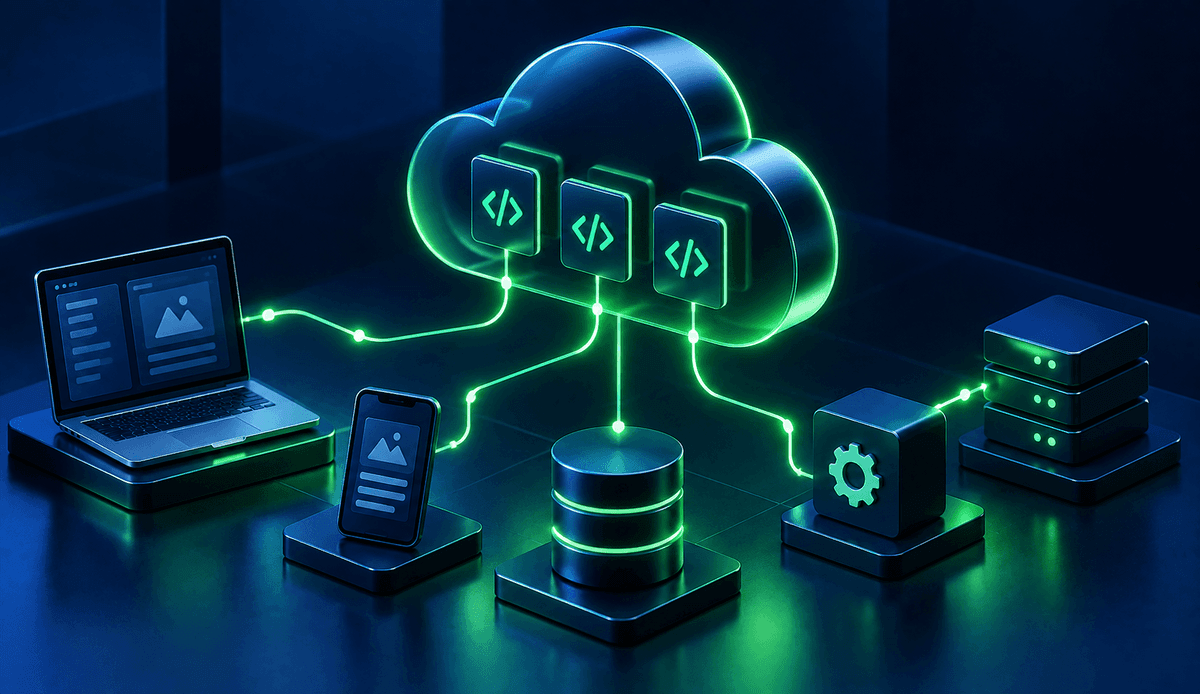
Serverless architecture is an approach to application development that does not require developers to directly manage the physical or virtual infrastructure on which servers run. Despite the word “server” in its name, servers do not actually disappear in these systems. Server setup, maintenance, and scaling are managed by the cloud provider.
Developers can instead focus primarily on the application's code and functionality. Based on factors such as resource consumption and execution time, the cloud infrastructure manages resources according to the application's needs.
How Does Serverless Architecture Work?
In serverless environments, specific application functions typically run as individual functions. When a user performs an action or a particular event occurs within the system, the relevant function is triggered.
For example, when a user uploads a file to a website, a function responsible for processing that operation can be triggered. Once the function completes its task, it does not necessarily need to continue running on a continuously active server.
The basic flow of a serverless model is generally as follows:
- A user or system initiates an operation.
- The relevant event triggers a serverless function.
- The cloud provider prepares the required execution environment.
- The function performs the required operation.
- Once the operation is complete, resource usage ends or the environment may be kept ready for reuse.
This structure can be useful in scenarios where an application does not need to consume high levels of resources continuously.
What Are the Advantages of Serverless Architecture?
One of the key characteristics of serverless architecture is that it delegates a significant portion of infrastructure management to the cloud provider. This allows developers to focus on application functionality rather than operational tasks such as server setup and capacity planning.
Key advantages include:
- Reduced server management: A significant portion of operating system, hardware, and infrastructure maintenance is handled by the provider.
- Automatic scaling: Resources can potentially be increased or decreased according to demand.
- Faster development: Developing applications with small, independent functions can simplify the development process.
- Flexible resource usage: Resource requirements can change based on application usage.
- Reduced operational workload: Development teams may spend less time managing infrastructure.
What Are the Disadvantages of Serverless Architecture?
Serverless architecture is not suitable for every project. Dependence on cloud providers, the execution model, and performance characteristics can introduce considerations that need to be addressed during development.
In particular, function execution times, provider limits, and delays known as cold starts should be considered when designing the project.
The main disadvantages include:
- Vendor dependency: An application may become heavily dependent on the services of a specific cloud platform.
- Cold starts: Restarting a function that has not been running for a while can introduce additional latency.
- Execution limits: Restrictions may apply to factors such as function duration, resource usage, or the number of requests.
- Debugging: Monitoring distributed functions can be more complex than monitoring traditional applications.
- Architectural complexity: Managing an application can become more difficult as the number of functions increases.
What Is the Difference Between Serverless and Traditional Server Architecture?
In a traditional architecture, setting up, configuring, and managing the capacity of the servers on which an application runs may be the responsibility of developers or operations teams. Servers typically run continuously based on the application's traffic requirements.
With a serverless approach, most of the infrastructure is managed by the cloud provider. An application can be divided into specific functions, which can be executed when needed.
Therefore, the fundamental difference between the two approaches is not simply whether servers are used. The key difference is who manages the infrastructure and how it is managed.
When Should Serverless Architecture Be Used?
Serverless architecture can be considered for projects where applications consist of independent functions triggered by specific events. It can be particularly useful for applications with variable traffic where automatic infrastructure scaling is desired.
When considering serverless architecture, the following questions can be evaluated:
- Does the application's traffic vary significantly throughout the day?
- Is reducing infrastructure management a priority?
- Is the application suitable for an event-driven architecture?
- Are the execution times and resource requirements of the functions compatible with platform limits?
- Is dependence on a specific cloud provider acceptable?
- Are suitable tools available for monitoring and debugging the application?
The answers to these questions can help determine whether serverless architecture is suitable for a particular project.
What Types of Projects Use Serverless Architecture?
The serverless approach can be used in projects where a specific event triggers an operation within the application. It can be considered in a variety of scenarios, from web applications to automation systems.
Some common use cases include:
- Web APIs: Backend functions can be created to handle requests from clients.
- File processing: Operations such as converting, analyzing, or classifying uploaded files can be triggered automatically.
- Notification systems: Email or other notification processes can be initiated when specific events occur.
- Data processing: Automated operations can be performed on data added to or updated in a database.
- Scheduled tasks: Automations that need to run at specific intervals can be created.
- Backend operations: Certain backend functions required by mobile and web applications can be implemented using serverless functions.
What Technologies Are Used in Serverless Architecture?
The serverless ecosystem includes function services and supporting tools provided by different cloud providers. These services allow developers to execute code based on specific events and connect it with other components of an application.
For example, services such as AWS Lambda, Azure Functions, and Google Cloud Functions provide serverless function execution models. In addition, various cloud services for requirements such as databases, API management, authentication, and monitoring can be incorporated into the architecture.
Is Serverless Architecture the Same as Microservices?
Serverless and microservices are not the same concept. Microservices refers to designing a large application as a collection of smaller, independent services. Serverless, on the other hand, is concerned with how application components are executed and how their underlying infrastructure is managed.
The two approaches can be used together. For example, some services within a microservices architecture can be implemented using serverless functions. However, not every microservices application needs to be serverless.
What Should You Consider When Adopting Serverless Architecture?
Before starting a serverless project, focusing only on simplifying infrastructure management is not enough. The application's execution model, data flow, performance requirements, and service limitations should all be evaluated together.
In particular, the events that will trigger the application and how functions will communicate with one another should be designed in advance. Logging, monitoring, error handling, and security processes should also be treated as integral parts of the architecture.
Serverless architecture does not eliminate servers. Instead, it is an approach that largely delegates server management to the cloud provider. It can be a useful option for variable traffic, event-driven operations, and independent backend functions. However, it should be evaluated according to the specific needs of each project.