What Are Vector Databases? Their Role in Artificial Intelligence Applications

 09.15.2026
Vector data is used in AI applications to meaningfully compare text, images, and other types of data. Vector databases make it possible to store this data and perform similarity searches quickly. In this article, we will explore what vector databases are and the role they play in AI applications.
What Is a Vector Database?
A vector database is a type of database that stores data as numerical vectors and focuses on identifying similarities between those vectors. Data such as text, images, or audio can be transformed into a numerical representation by an AI model.
These numerical representations are generally called embeddings. By storing these embeddings, a vector database helps identify data that is similar in terms of meaning or characteristics.
For example, when a user searches for "I want to learn about artificial intelligence," the system can find not only content containing the same words but also content that is semantically similar.
How Does a Vector Database Work?
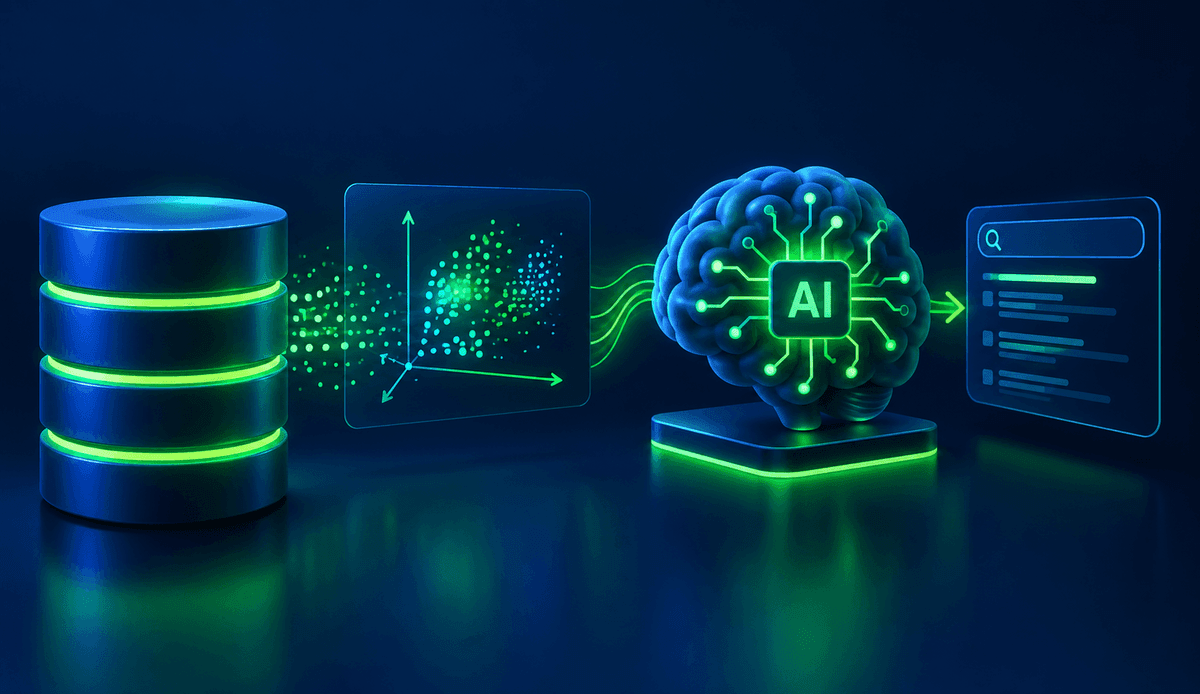
The basic principle behind vector databases involves converting data into vectors and calculating the similarity between these vectors. The exact process may vary depending on the model and database being used.
In simplified terms, the process consists of the following steps:
- Data is converted into a numerical vector using an embedding model.
- The generated vector is stored in the vector database.
- The user's query is similarly converted into a vector.
- The system searches for vectors that are close to the query vector.
- The most similar results are returned to the application.
This approach can be particularly useful in applications where semantically related results need to be found within large amounts of content.
What Is an Embedding?
An embedding is a numerical representation of data that makes it easier for machines to compare different pieces of information. When a piece of text is processed by an embedding model, it is transformed into a vector consisting of numbers that represent the meaning of the text to a certain extent.
Vectors representing content with similar meanings may be closer to one another. This allows systems to evaluate semantic relationships between pieces of content without relying solely on keyword matching.
Why Are Vector Databases Used in AI Applications?
AI applications often need to make sense of large amounts of data. Traditional keyword searches may not always be sufficient. Vector search can help identify content that is semantically related to a query.
This capability becomes particularly valuable in applications where users ask questions using natural language. Even when the words used by the user differ from the expressions in the underlying data, the system can still find results that are similar in meaning.
What Are the Use Cases of Vector Databases?
Vector databases can be used in a wide range of AI applications. Their use cases vary depending on the needs of the application and the types of data involved.
Some of the key use cases include:
- Semantic search: Finding content that is semantically similar to a user's query.
- Recommendation systems: Recommending similar items based on user or content characteristics.
- Question-answering systems: Finding relevant information from documents or internal organizational resources.
- Document search: Discovering similar content across large collections of documents.
- Image search: Finding similar results based on the characteristics or content of images.
- AI assistants: Matching relevant information from a knowledge source with a user's query.
What Is the Difference Between a Vector Database and a Traditional Database?
Traditional databases are generally used to manage structured data through specific fields and queries. For example, a product's name, category, or stock information can be stored in specific columns.
Vector databases, on the other hand, are specialized in identifying similarities between numerical vectors. Therefore, the primary purpose of the two approaches is not exactly the same.
It is also not necessary to use only a vector database in an application. Depending on the requirements, traditional databases and vector search infrastructure can be used together.
How Is Vector Similarity Measured?
Various mathematical methods can be used to determine which pieces of data are similar to a query. These methods calculate the proximity between the query vector and the vectors stored in the database.
One common method is cosine similarity. This method focuses on measuring the similarity between the directions of two vectors.
Other methods, such as Euclidean distance and dot product, can also be used. The choice of method depends on the data structure, embedding model, and requirements of the application.
How Are Vector Databases Used in RAG Systems?
RAG stands for "Retrieval-Augmented Generation." In this approach, an AI model can retrieve relevant information from external or application-specific knowledge sources before generating a response.
A vector database can play an important role in this process. Documents are converted into embeddings and stored in the database. When a user asks a question, the question is also converted into a vector, and relevant content is retrieved.
The retrieved content can then be provided to the AI model as context. This allows the model to make use of information provided by the application rather than relying solely on its general training data.
What Should You Consider When Choosing a Vector Database?
When choosing a vector database, focusing only on search performance may not be sufficient. Factors such as the amount of data, scalability requirements, existing technology infrastructure, and the development team's experience should be evaluated together.
The following factors can be considered during the evaluation process:
- Supported data and vector features
- Search performance
- Scalability
- Filtering capabilities
- Integration options
- Data management and access controls
- Pricing structure
- Ease of use and developer experience
What Are the Advantages of Vector Databases?
The primary advantage of vector databases is that they make it easier to integrate semantic similarity search into AI applications. Finding content that is relevant to a query within large data collections can improve the user experience of many applications.
This approach can be particularly useful for search and question-answering systems that work with natural language. In addition, the ability to compare different types of data through their vector representations expands the range of potential use cases.
What Are the Limitations of Vector Databases?
Vector databases may not always be the most suitable solution for every search problem. The quality of results depends on factors such as the embedding model, data preparation process, and search method.
In addition, as storage and search requirements increase with larger datasets, the underlying infrastructure needs to be designed appropriately. Therefore, it is important to evaluate the use case and technical requirements before integrating a vector database into an application.
Vector databases provide powerful infrastructure for establishing semantic relationships between data in AI applications. They can play an important role in approaches such as semantic search, recommendation systems, and RAG. When combined with the right embedding model and an appropriate search method, they can enhance the ability of AI applications to work effectively with data.