Data Analysis with Artificial Intelligence: A Guide to Transitioning from Excel to Python

 09.17.2026
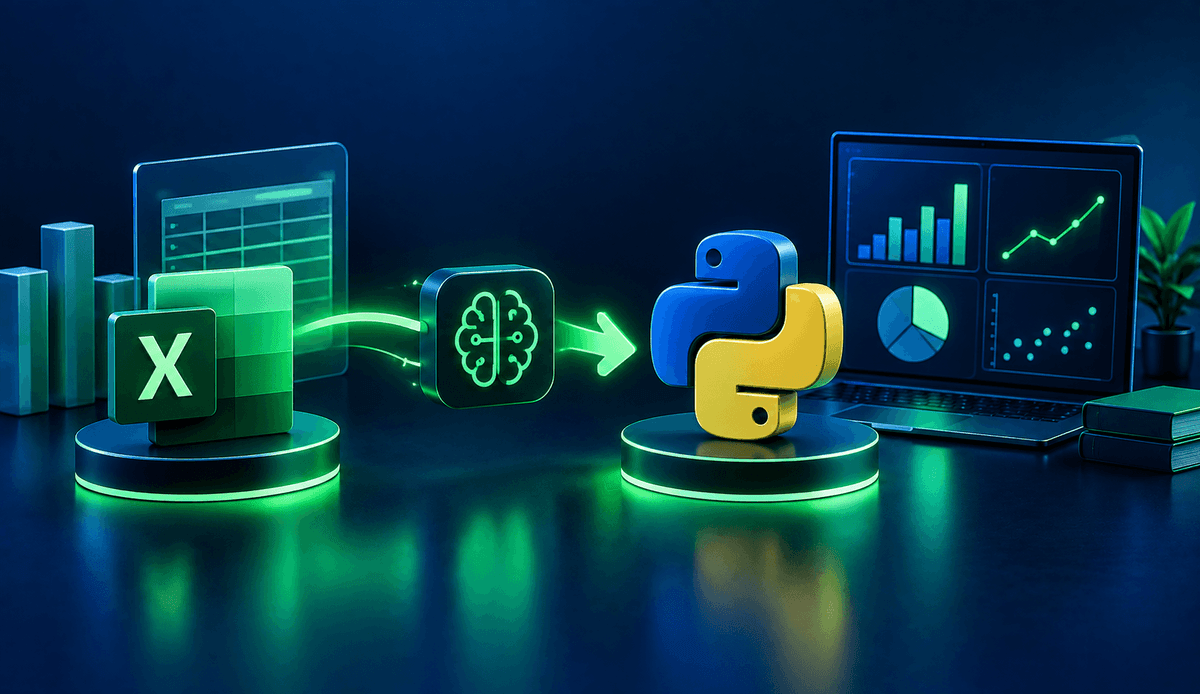
Artificial intelligence can complement the tools offered by Excel in data analysis processes, making it possible to perform more comprehensive analyses. In this guide, we will explore why you might move from Excel to Python, the role of AI in the analysis process, and how to get started with data analysis using Python.
How is data analysis done with Excel?
Excel is a widely used tool for organizing, filtering, calculating, and visualizing data through charts. It provides a practical working environment for getting quick results, particularly with small and medium-sized datasets.
With formulas, PivotTables, filters, and charts, users can perform many analyses without writing code. However, as the amount of data grows or analyses need to be repeated regularly, more programmable tools may be needed.
At this point, Python can be used to automate data analysis processes and create more flexible analyses.
Why move from Excel to Python?
Rather than choosing between Excel and Python, it is more accurate to think of the two tools as serving different needs. While Excel is useful for quick and visual tasks, Python can be more effective for complex and repeatable data operations.
Common reasons for moving to Python include:
- Automating repetitive analyses
- Working with large datasets
- Combining multiple data sources
- Performing more comprehensive data cleaning
- Conducting advanced statistical analyses
- Turning analysis processes into reusable code
- Using AI and machine learning tools
Therefore, learning Python does not mean completely leaving behind your Excel experience. The two tools can be used together at different stages of the process.
What is Python used for in data analysis?
Python can be used to process and analyze data through programming. By defining specific operations in code, it becomes easier to run the same analysis on different datasets.
For example, if the same Excel file needs to be cleaned every month, these processes can be automated with Python. Instead of manually repeating the same steps each time, you can use pre-written code.
Python’s extensive library ecosystem for data science also makes it possible to perform a wide range of data analysis tasks.
Which libraries are used for data analysis with Python?
While Python itself provides fundamental programming capabilities, various libraries can be used for data analysis. These libraries are designed to make specific data-related tasks easier to perform.
For beginners, the following tools are particularly useful:
- Pandas: Used to read, organize, filter, and analyze tabular data.
- NumPy: Used for numerical calculations and array-based operations.
- Matplotlib: Can be used to visualize data through charts.
- Seaborn: Makes it easier to create statistical data visualizations.
- Jupyter Notebook: Helps bring code, explanations, and analysis results together in a single workspace.
Instead of trying to learn all these tools at once, starting with basic data operations and adding new tools as needed can provide a more manageable learning experience.
How can an Excel file be read with Python?
One of the first steps when moving from Excel to Python is importing existing files into a Python environment. The Pandas library can be used to read Excel files and process them as tables.
For example, after importing data from a sales file into Python, you can examine missing values, filter specific columns, or perform various calculations.
This approach allows many tasks that are performed manually in Excel to be defined through code. The code can then be reused with other files that have a similar structure.
How can AI be used in data analysis?
AI should not be considered a tool that performs every step of data analysis on its own. Instead, it can assist with tasks such as writing code, understanding data structures, exploring analysis methods, and interpreting results.
For example, a developer or analyst can ask an AI tool how to filter a specific dataset using Pandas. The generated code can then be reviewed and adapted based on the structure of the data before being used.
AI can be used in data analysis for tasks such as:
- Generating Python code
- Converting Excel formulas into Python code
- Planning data cleaning steps
- Preparing code for creating charts
- Helping understand code errors
- Summarizing analysis results
- Exploring different analysis methods
An important point to keep in mind is that AI-generated code should not be assumed to be correct by default. The code should be checked to ensure that it is appropriate for the data structure and the purpose of the analysis.
How can Excel formulas be converted to Python?
One of the topics Excel users encounter when moving to Python is learning the Python equivalent of familiar formulas. However, rather than trying to create a one-to-one formula mapping, it is more useful to understand the programming logic behind the same operation.
For example, a formula used to calculate the sum of values in a column in Excel can be implemented using Pandas functions in Python. Similarly, filtering, sorting, and grouping operations can also be performed with Python code.
AI can be used as an explanatory assistant during this transition. Users can describe an Excel operation they already know and ask how to perform the same task with Pandas.
How should an Excel user start learning Python?
Excel experience can provide a useful foundation when starting data analysis with Python. Concepts such as tables, columns, rows, filtering, and grouping appear in both environments.
Instead of immediately moving on to complex projects, it may be easier to connect familiar Excel practices with their Python equivalents during the learning process.
A possible learning path for beginners is:
- Learn basic Python syntax
- Understand variables and data types
- Learn lists, dictionaries, and conditional statements
- Read tabular data with Pandas
- Practice data filtering and sorting
- Examine missing and incorrect data
- Create basic charts
- Process Excel files with Python
- Build small data analysis projects
Applying each newly learned concept to a real dataset can help reinforce theoretical knowledge.
What should you consider when learning data analysis with AI?
AI can be a useful assistant that speeds up the learning process, but it does not replace fundamental concepts. Especially when starting out, it is important to focus on understanding why the generated code works.
When obtaining code from an AI tool, it can be helpful to examine the code line by line, research the functions being used, and test it with different data examples. This helps you learn the logic behind data analysis rather than simply obtaining working code.
In addition, before sharing personal, confidential, or access-restricted data with AI tools, you should consider the data policies of the service you are using as well as your organization’s rules.
Should you use Excel or Python?
Excel and Python serve different purposes. Excel can be practical for simple calculations, quick data exploration, and manual reporting.
Python can be preferred for repeatable analyses, automation, large datasets, and more comprehensive data processing workflows. Therefore, rather than completely excluding one of the two tools, it can be useful to use them together depending on the requirements.
For example, data can be received in Excel format, cleaned and analyzed with Python, and the results can then be presented again in Excel or through other visualization tools.
Moving from Excel to Python is not simply about learning a new programming language. It also means adopting a more programmable approach to data analysis. AI can support this process by helping with coding, learning, and analysis tasks. For sustainable learning, it is important to understand the fundamental concepts and verify the generated results.