Google Just Made a Leap in Weather Forecasting: Introducing WeatherNext 3

 04.09.2026
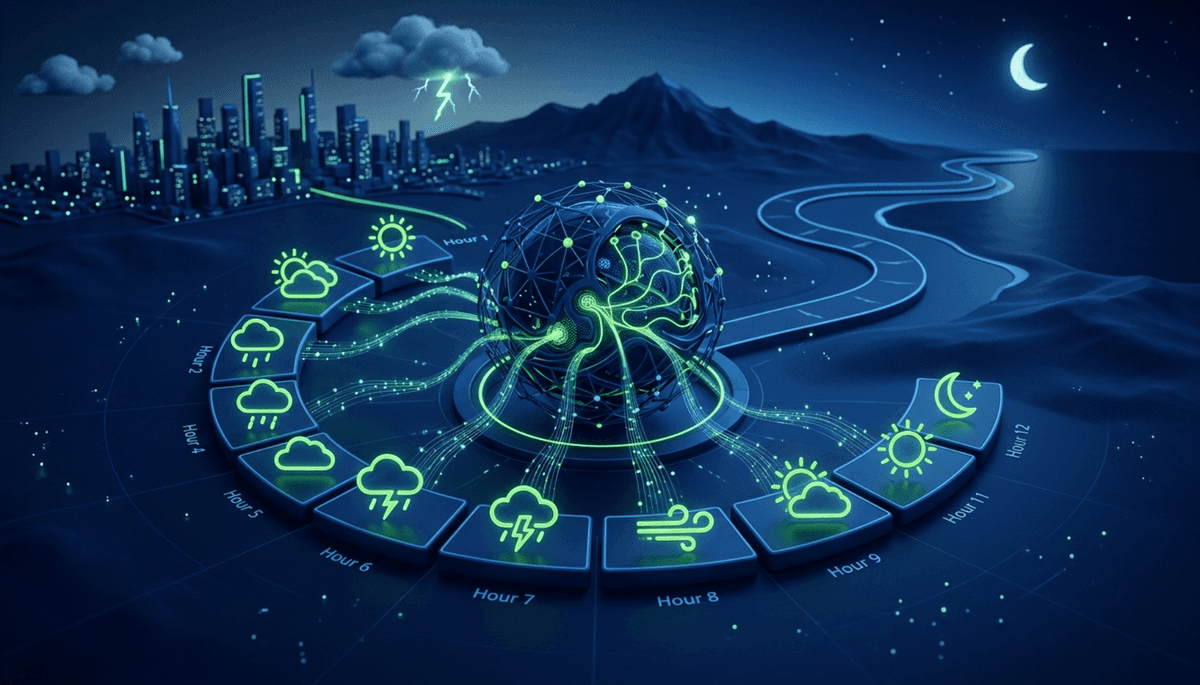
Google DeepMind and Google Research have rolled out WeatherNext 3, which the company describes as its most advanced global weather AI model to date. Unlike traditional supercomputer simulations, the model feeds directly on real-time satellite imagery, generating a new forecast every single hour — a shift that's being seen as a major turning point for the industry.
Solving the Six-Hour Lag Problem
Most AI-based weather forecasting models built so far have been trained on data produced by physics-based numerical weather prediction (NWP) systems running on supercomputers. The biggest weakness of this approach is that such data typically arrives with roughly a six-hour delay, which can lead to forecasting errors for fast-changing events like rainfall or sudden temperature shifts.
WeatherNext 3 tackles this by combining imagery from geostationary satellites around the world with historical weather analysis. As a result, the system can refresh itself 24 times a day — essentially once every hour. This approach can cut the typical data lag from around seven hours down to just three or four. While most AI weather models rely on data from the European Centre for Medium-Range Weather Forecasts (ECMWF), which takes about five hours to compile, WeatherNext 3 breaks that cycle by switching to live observational data.
A Five-Fold Jump in Resolution
The new model can forecast core surface variables like temperature and moisture at up to 5-kilometer resolution, other surface variables at 10 kilometers, and atmospheric variables such as wind speed at 25 kilometers. Compared to the previous generation, WeatherNext 2 — which produced forecasts only every six hours at a 25-kilometer resolution — this represents a roughly five-fold sharper global picture.
Part of what makes this precision possible is that the model is trained directly on sparse weather station observation data. That allows it to generate far more localized results in places where temperature and humidity can shift dramatically over short distances, such as coastlines, valleys, and mountainous regions. Google says this is a particularly important step for Latin America, Africa, and the Asia-Pacific region, areas that have historically been underserved by high-resolution forecasting.
On the technical side, the model itself has grown: WeatherNext 3 has roughly 2.4 times more parameters than WeatherNext 2. It builds on the Functional Generative Network (FGN) architecture that underpinned its predecessor, with the latent size increased from 768 to 1024 and the mesh transformer depth expanded from 24 to 32 layers. The production version was trained on data through the end of June 2026, and the system is designed to produce 15-day, 64-member ensemble forecasts.
Up to 60% More Accurate Rain Forecasts
According to Google, the model's most notable achievement is in precipitation forecasting. The company trains it on NASA's satellite-based IMERG data along with its own global precipitation reanalysis built from satellite radar. In medium-range global forecasts, accuracy improves by up to 60% against IMERG data, up to 30% against MRMS data, and up to 10% for short-range forecasts measured against rain gauge readings, depending on the data source used.
For forecasts a day or more out, users can expect up to 50% more accurate precipitation predictions — with the biggest gains coming in regions where forecasts have historically been less reliable.
Built-In Data for Renewable Energy
Another standout feature of WeatherNext 3 is that it was built with wind and solar energy in mind. The model can forecast wind speeds at 100 meters — roughly turbine height — and also provides high-resolution cloud cover and solar radiation data for solar power planning. The goal is to help grid operators and renewable energy developers more accurately predict how much power their wind and solar assets will generate and match that output with consumer demand.
Now Live Across Google's Products
As of today, WeatherNext 3 is being integrated into weather experiences across Google Search, the Gemini app, Google Maps, the Google Maps Platform Weather API, and Google Earth Engine. Developers and researchers can query the model's output through BigQuery and Earth Engine, or download it directly from Google Cloud Storage. A tool called Weather Lab has also been made available for those who want to visualize the model in action.
Google says WeatherNext 3 came out on top in independent testing on Brightband's Operational WeatherBench platform, which benchmarks weather models against their rivals. Samier Merchant, a senior Google engineer, says this marks the first time these core variables are directly powering so many of the company's products. DeepMind research lead Ferran Alet notes that the model is designed to approximate noisy physics under conditions of incomplete data and limited compute — in other words, rather than solving classical physics equations outright, the system learns patterns from massive datasets.
Limitations and a Word of Caution
In its announcement, Google is careful to note that the model remains an experimental AI system, and it points users toward local meteorological agencies and national weather services for official forecasts, severe weather warnings, and public safety advisories. As the company itself puts it, the atmosphere will always retain a degree of unpredictability — but by training on real-world observations and moving past the constraints of traditional modeling, WeatherNext 3 is expected to bring forecasts much closer to what's actually happening on the ground.
For countries with highly varied terrain — coastlines, mountain ranges, and valleys where microclimates shift over short distances — the jump to 5-kilometer resolution is expected to noticeably improve the quality of local forecasts people see in everyday products like Search, Maps, and Gemini. That said, official and legally binding weather forecasts and disaster warnings will still remain the responsibility of national meteorological authorities.