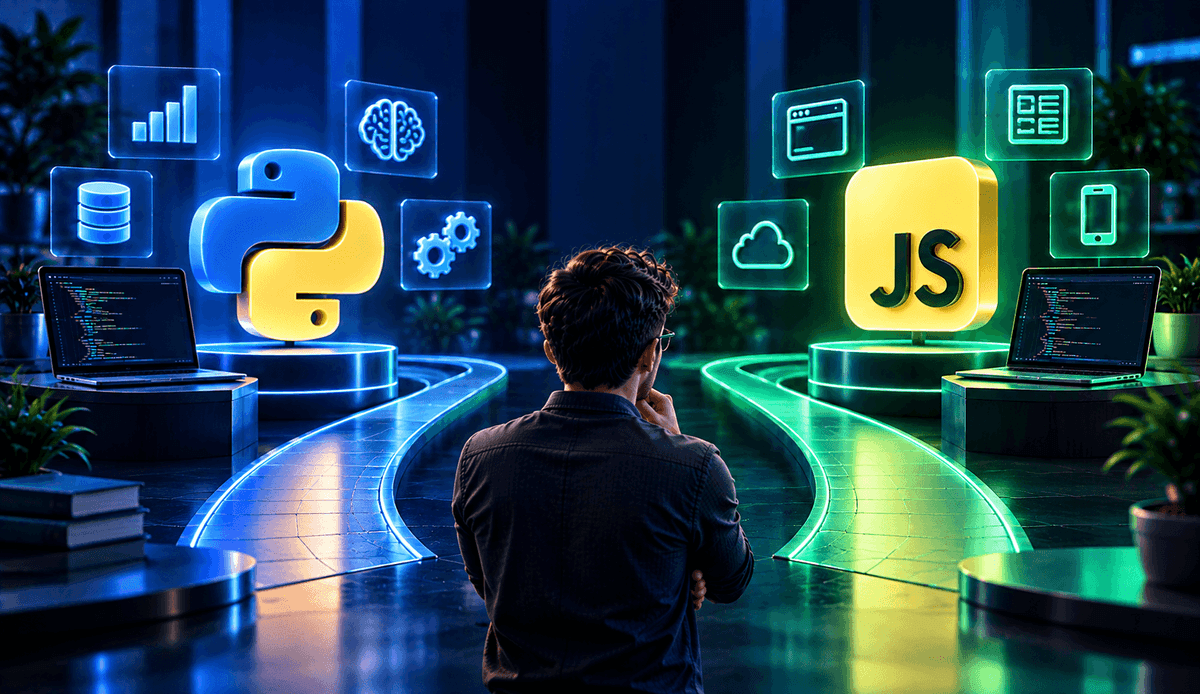
Python or JavaScript? A Guide to Choosing Your First Programming Language

 10.16.2026
One of the most common questions among aspiring programmers is whether they should learn Python or JavaScript first. Both languages are used in different fields and offer several advantages for beginners. In this guide, you will learn about the differences between Python and JavaScript, their use cases, and the factors to consider when choosing your first programming language.
What Is Python?
Python is a programming language known for its readable and straightforward syntax. Its English-like structure can make it easier for beginners to understand the logic behind programming.
Python is used in various fields, including data analysis, artificial intelligence, machine learning, automation, and web development. Its extensive library ecosystem provides reusable tools for a wide range of projects.
For example, you can use Python to write a program that automatically organizes files, analyze datasets, or develop machine learning models. You can also build web applications using frameworks such as Django and Flask.
What Is JavaScript?
JavaScript is a programming language primarily used to make websites interactive. Features such as opening a menu when a button is clicked, validating form inputs, or updating a page based on user actions can be implemented with JavaScript.
JavaScript is not limited to web browsers. With runtimes such as Node.js, it can also be used on the server side. Technologies such as React, Vue, and Angular enable developers to build interfaces for modern web applications.
By learning JavaScript, you can work on user-facing interfaces and, with the right tools, develop the server-side components of applications as well. This makes it a comprehensive starting point for anyone interested in web development.
What Are the Differences Between Python and JavaScript?
Python and JavaScript are two popular programming languages developed with different goals, yet both can be used in a wide range of projects. Their main differences lie in their syntax, use cases, and execution environments.
| Feature | Python | JavaScript |
|---|---|---|
| Syntax | Simple structure based on indentation | Frequently uses structures such as curly braces and semicolons |
| Key areas | Data analysis, artificial intelligence, automation | Web interfaces, interactive applications |
| Web development | Django, Flask, FastAPI | React, Vue, Node.js |
| Data science | Widely used with a rich library ecosystem | Used in specific data processing and visualization scenarios |
| Browser execution | Not a standard browser language that runs directly in browsers | One of the core programming languages of web browsers |
| Beginner experience | Suitable for learning fundamental concepts with straightforward syntax | Supports hands-on learning by adding interactivity to web pages |
Both languages can be used to learn fundamental programming concepts such as variables, conditions, loops, functions, and data structures. Therefore, when choosing between them, consider not only which language seems easier but also the types of projects you want to build.
Is Python or JavaScript Easier to Learn?
Python is often preferred by beginners because of its readable syntax. For example, the expressions used to write conditional statements and loops are relatively straightforward, making it easier to follow what the code does.
JavaScript is also accessible to beginners. However, using it alongside technologies such as HTML and CSS during web development can increase the number of concepts you need to learn initially. On the other hand, seeing your code produce an immediate visual result in a browser can make the learning process more engaging.
The important thing is not to assume that one programming language is universally easier than the other. The learning experience varies depending on your previous technical knowledge, the resources you use, and the projects you work on.
What Is Python Used For?
Python is a versatile programming language used across different disciplines. It is particularly popular for working with data, automating repetitive tasks, and developing artificial intelligence applications.
Some of the main areas where you can use Python include:
- Artificial intelligence and machine learning: Developing models that learn patterns from data.
- Data analysis: Organizing, examining, and visualizing datasets.
- Automation: Automating file operations and repetitive tasks.
- Web development: Building web applications with tools such as Django, Flask, and FastAPI.
- Scientific computing: Performing numerical analysis and research-oriented calculations.
If you want to pursue these fields, Python can be a good starting point. In particular, those interested in data analysis and artificial intelligence can move on to relevant libraries after learning the fundamentals of programming.
What Is JavaScript Used For?
JavaScript can be used to develop various types of applications because of its close connection to web technologies. In addition to writing code that runs in browsers, developers use it for server-side applications and certain mobile and desktop development workflows.
Some of the main areas where you can use JavaScript include:
- Web interface development: Creating pages that users can interact with.
- Frontend development: Building the visible parts of web applications using HTML and CSS.
- Backend development: Developing server-side applications with Node.js.
- Full-stack web development: Working on both frontend and backend using the JavaScript ecosystem.
- Mobile app development: Building applications for multiple platforms with tools such as React Native.
If you want to develop websites, interactive interfaces, or web-based products, learning JavaScript provides a direct path toward these goals.
How Should You Choose Your First Programming Language?
When choosing your first programming language, focus on your learning goals rather than popularity alone. Learning a language is not simply about memorizing all its features. It also involves understanding problem-solving approaches and applying what you learn through projects.
Consider the following questions when making your decision:
- Are you interested in artificial intelligence and data analysis? Start with Python and progress toward data processing and machine learning.
- Do you want to build websites? JavaScript allows you to develop applications directly in the browser.
- Do you want to automate repetitive tasks? Python offers a practical starting point for file and data operations.
- Do you want to learn both frontend and backend development? The JavaScript ecosystem allows you to work in both areas.
- Are you unsure which field to pursue? Try small projects with both languages to discover which better matches your interests.
Your answers can help you decide which language to learn first. Once you have made your choice, focusing on the fundamentals and completing small projects rather than frequently switching between languages can make your learning process more effective.
Where Should You Start Learning Python and JavaScript?
Regardless of which language you choose, you should begin by learning fundamental programming concepts. Topics such as variables, data types, conditions, loops, functions, and lists provide a shared foundation across many programming languages.
Next, apply what you have learned by building small projects. With Python, you could create a simple calculator or a file-organizing program. With JavaScript, you could develop an interactive to-do list or a form validation application.
As your projects become more advanced, you can also learn skills such as debugging, using Git, and improving code structure. This way, you will gain experience not only with programming syntax but also with the fundamental stages of software development.
When choosing between Python and JavaScript, the best approach is to consider your goals and interests. Python offers a strong starting point for data analysis, artificial intelligence, and automation, while JavaScript provides a direct path into web development. Practicing regularly and building projects with either language are essential to improving your programming skills.