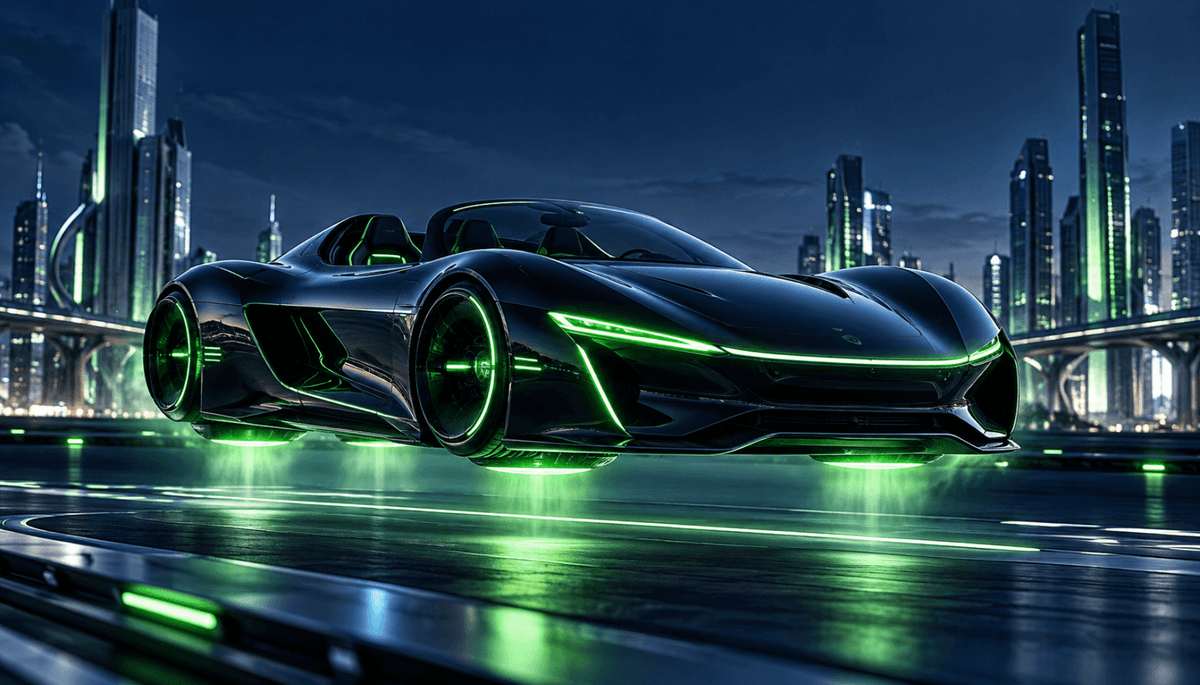
Tesla Unveils a Flying Roadster: What Does the New Model Offer?

 16.10.2026
Tesla Unveils the New Roadster: Can It Really Fly?
Tesla brought its long-awaited next-generation Roadster back into the spotlight with a striking presentation held on October 15, 2026. The electric sports car drew attention not only for its acceleration performance, but also for its ability to lift off the ground and perform controlled aerial maneuvers using a special propulsion system.
During the presentation, the Roadster prototype traveled along a specially designed curved ramp, continued moving while attached to the inverted section of the surface, and then launched into the air. While airborne, the vehicle rotated before landing back on its wheels.
In another demonstration, the Roadster jumped over vehicles in front of it and maneuvered in the air.
Following these demonstrations, one question quickly became the main topic of discussion: Has Tesla really developed a flying car?
The answer depends on how the term “flying” is defined.
Does the Tesla Roadster Really Fly?
The Roadster prototype shown during the presentation genuinely left the ground and performed controlled movements while airborne.
However, at this stage, it would not be accurate to describe the new Roadster as a conventional flying car capable of traveling through the sky for extended periods.
The system that allows the vehicle to lift off relies on high-pressure air thrusters positioned on and around the Roadster. These thrusters generate extremely powerful bursts of force for short periods, helping the car accelerate and, in certain configurations, rise off the ground.
Tesla has not yet disclosed the maximum altitude the Roadster can reach in flight mode, how long it can remain airborne, or how far it can travel in this way.
For this reason, the technology demonstrated should currently be viewed as a high-performance propulsion system designed for short-duration lift-off and aerial maneuvers rather than long-distance flight.
How Does the Roadster Lift Off?
One of the most unusual technologies featured in the new Roadster is its high-pressure air thruster system.
According to Tesla, the vehicle’s thrusters operate using ultra-high-pressure air. The system directs compressed air outward at high speed to generate additional thrust.
During the presentation, thrusters located at the rear of the Roadster were used in acceleration demonstrations.
A more advanced version of the system is intended not only to propel the vehicle forward, but also to allow it to move upward and change direction while airborne.
Thanks to the propulsion system used in the prototype, the vehicle was able to leave the ramp, rotate around its own axis in the air, and return to the ground in a controlled manner.
How Did the Roadster Drive on an Inverted Ramp?
One of the most striking moments of the presentation was the Roadster driving along the inverted section of a tall, curved ramp.
This maneuver was not performed directly by the flight thrusters. Instead, it relied on a powerful suction system located underneath the vehicle.
The system manages airflow beneath the car to pull it strongly toward the road surface.
According to Tesla, the system can generate approximately 2 g of suction force.
This allows the Roadster to produce extremely high levels of downforce even at relatively low speeds. During the demonstration, the vehicle remained attached to the inverted section of the ramp to showcase the strength of the system.
The same technology could also be used during normal road and track driving to improve cornering performance and grip.
0–60 mph in Less Than One Second
One of the most remarkable aspects of the new Roadster is its acceleration performance.
Tesla says the Roadster is capable of accelerating from 0 to 60 mph, or approximately 97 km/h, in less than one second.
During the first acceleration demonstration, a time of roughly one second was shown. In a second attempt, the display indicated a figure of approximately 0.8 seconds.
However, there is an important distinction to make.
These figures are based on Tesla’s own prototype demonstration. It is not yet known whether the production Roadster will achieve the same result in independent testing.
For now, the figure should therefore be considered a target performance demonstrated by Tesla with a prototype, rather than a confirmed production-car performance specification.
Top Speed Expected to Exceed 230 mph
Another major performance target announced for the new Roadster is its maximum speed.
Tesla says the vehicle is being developed to exceed 230 mph, or approximately 370 km/h.
The Roadster’s active aerodynamics and suction system are designed to support this level of high-speed performance.
An active aerodynamic wing at the rear can adjust its position depending on driving conditions. The system can provide additional downforce or alter the vehicle’s aerodynamic characteristics when required.
Tesla’s goal with the Roadster is not limited to achieving extreme straight-line speed. The company is also aiming to improve acceleration, braking, and cornering performance as an integrated package.
What Is the Range of the New Tesla Roadster?
According to Tesla’s latest statements, the new Roadster is targeting a driving range of more than 300 miles, or over approximately 480 kilometers, on a single charge.
This figure is lower than some of the range targets Tesla announced for the Roadster in previous years.
However, the Roadster shown in 2026 features a significantly different technical configuration from the original prototype introduced years earlier.
The latest version places greater emphasis on performance-oriented technologies such as the suction system, active aerodynamic components, and high-pressure air thrusters.
Tesla has not yet provided detailed information regarding the final battery capacity, charging time, or real-world range of the production vehicle.
The New Roadster Will Be Offered in Three Versions
Tesla plans to offer the new Roadster in three different variants:
Performance, Thrust and Rocket.
Performance
Performance will be the version of the Roadster most focused on conventional road use.
The two-seat model will feature an active aerodynamic system and a multi-mode suction system.
These technologies are designed to improve stability at high speeds and generate significant downforce, particularly during cornering.
Thrust
The Thrust version will also feature a two-seat configuration.
In addition to the aerodynamic and suction systems found in the Performance model, the Thrust version will include propulsion thrusters designed to assist acceleration.
These thrusters will play an important role in achieving the Roadster’s extraordinary 0–60 mph acceleration performance.
Rocket
The most unconventional version of the Roadster family will be the Rocket.
This model is being designed as a single-seat vehicle and is described by Tesla as the version equipped with a full flight system.
Additional thrusters positioned around the vehicle are intended to allow the Rocket version to move forward, upward, and sideways, as well as rotate while airborne.
This version will not be offered through the standard reservation system. Tesla plans to position the Rocket as an exclusive Roadster variant available by invitation only.
Will Every Tesla Roadster Be Able to Fly?
No.
One of the biggest potential misunderstandings surrounding the Roadster is the assumption that every version will be capable of performing the aerial maneuvers demonstrated during the presentation.
The Performance version will feature active aerodynamics and a suction system, but it will not include the full flight system.
The Thrust version will include thrusters designed primarily to assist acceleration.
The model Tesla describes as having the complete flight system will be the Rocket version.
Therefore, it would not be accurate to say that every Roadster that eventually reaches the road will be capable of lifting off.
How Much Will the New Tesla Roadster Cost?
Tesla has not yet announced the final retail price of the new Roadster.
However, the reservation system has reopened.
Tesla is asking for a $50,000 reservation payment for the Performance version and $250,000 for the Thrust version.
It is important to note that these figures are not the vehicles’ final purchase prices.
They are reservation payments required to secure a Roadster.
The Rocket version is not available through the standard reservation system and will instead be offered by invitation only.
Tesla is expected to announce final pricing closer to the start of production.
When Will the Tesla Roadster Enter Production?
The next-generation Roadster was first revealed in 2017, with deliveries originally expected much earlier.
However, the project was delayed several times over the following years.
During the new presentation on October 15, 2026, Tesla announced that it is targeting 2028 for the start of Roadster production.
For this reason, it is too early to assume that the vehicles shown during the presentation will be identical to the final production Roadster.
The aerodynamic design, technical specifications, safety systems, and other details may still change before production begins.
Everyday Use of the Flight System Remains Unclear
Although the latest Roadster presentation revealed a number of technical details, several important questions about the flight system remain unanswered.
Tesla has not yet provided detailed information about:
- how high the vehicle will be able to fly,
- how long it can remain airborne,
- how much energy or compressed air the flight system consumes during a single use,
- how long it takes for the propulsion system to become fully ready again,
- or in which regions the flight capabilities will legally be permitted.
Tesla has also indicated that some features may not be available everywhere due to regional regulations.
As a result, the production version will ultimately determine how the Roadster’s demonstrated flight capability can be used in everyday conditions.
Has Tesla Really Built a Flying Car?
Following the 2026 presentation, this question can be answered much more clearly than in previous years.
Tesla demonstrated a functioning Roadster prototype that could leave the ground, rotate in a controlled manner while airborne, and land back on its wheels.
The vehicle’s ability to lift off is therefore no longer simply a concept or a future promise.
However, it should not be confused with a conventional flying car capable of remaining in the air for long periods and traveling between cities.
The Roadster’s demonstrated aerial capabilities rely on short-duration, high-power maneuvers generated by high-pressure thrusters.
Tesla has not yet announced a sustained flight time or flight range.
For now, the most accurate way to describe the new Roadster is as a combination of a high-performance electric sports car and an experimental flight system capable of short-duration aerial maneuvers.
How far the Roadster can actually fly, how the system will operate in customer vehicles, and how practical its flight capabilities will be in everyday use are expected to become clearer as Tesla approaches its targeted 2028 production period.
For now, one thing is certain: with the new Roadster, Tesla is not only attempting to redefine how fast a car can go, but also to push the boundaries of what a car can do.