What is RAG (Retrieval-Augmented Generation)? How Is It Used in AI Projects?

 09.16.2026
RAG is an approach that enables AI models to find and use relevant information from external sources before generating a response. In this article, we will explore what RAG is, how it works, its key components, and the purposes for which it can be used in AI projects.
What is RAG?
RAG stands for Retrieval-Augmented Generation. It refers to an approach designed to support the response-generation process of large language models with information retrieved from external sources.
Instead of generating responses based solely on the information learned during training, an AI model using the RAG approach can also use sources provided to it. These sources can include documents, web pages, internal company information, or structured data.
RAG is particularly useful in applications that need to generate responses based on a specific set of information. For example, it can be used to develop an assistant that understands a company’s documents and answers user questions based on those documents.
How does RAG work?
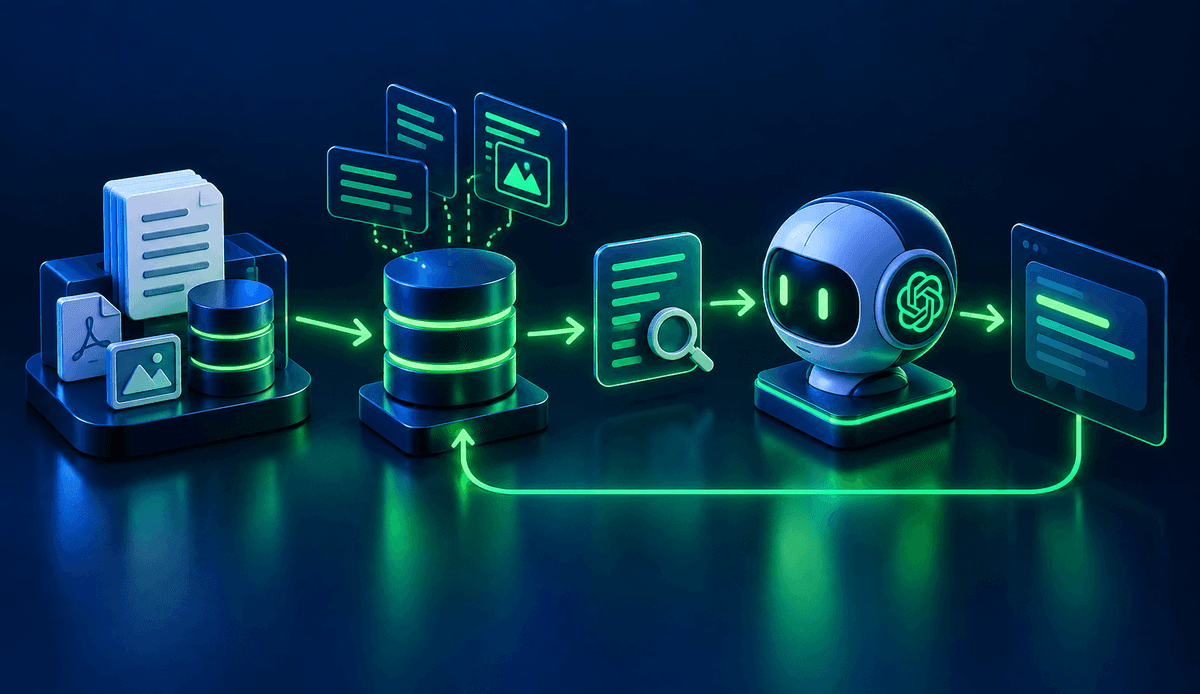
At the core of a RAG system is a two-stage process: finding relevant information and using that information to generate a response. When a user asks a question, the system first searches its available information sources.
The relevant content that is found is then provided to the language model as context. The model uses this context to generate a response that is relevant to the user’s question.
A simplified RAG workflow can be described as follows:
- The user asks a question.
- The system searches for information related to the question.
- Relevant content is selected.
- The selected content is sent to the AI model.
- The model generates a response using the provided context.
This structure allows information from specific sources to be incorporated into the response process instead of relying solely on the model’s general knowledge.
What are the main components of a RAG system?
A RAG architecture consists of several key components that perform different tasks. These components handle various stages, from preparing data to retrieving relevant content and generating responses.
The main components include:
- Data sources: Content such as documents, web pages, PDFs, or internal company information.
- Embedding model: Converts text into numerical vectors that represent its meaning.
- Vector database: Stores the generated vectors and helps find similar content.
- Retriever: Retrieves content related to the user’s question from the available data sources.
- Large language model (LLM): Generates a response using the retrieved information.
How these components are structured can directly affect the performance and user experience of a RAG application.
What is the relationship between RAG and vector databases?
Vector databases play an important role in retrieving relevant information in RAG systems. Text is converted into numerical vectors using embedding models, and these vectors can then be stored in a database.
When a user asks a question, the question is similarly converted into a vector. The system can search for content that is semantically close to the question vector and retrieve the relevant sections.
This approach can help find content that is similar in meaning rather than searching only for content containing the exact same words.
What is the difference between RAG and fine-tuning?
RAG and fine-tuning are different approaches used to adapt AI models to specific needs. RAG enables a model to access external information sources when generating a response, while fine-tuning refers to an additional training process designed to modify a model’s behavior or improve its performance on specific tasks.
With the RAG approach, information sources can be updated when necessary. For example, when company documents change, the relevant content in the knowledge source can be updated instead of retraining the model.
Fine-tuning, on the other hand, may be more suitable for working on a specific output format, task, or behavior. The appropriate approach depends on the goals of the project.
What AI projects can use RAG?
RAG can be used in various AI applications that need to generate responses based on specific information sources. It can be particularly useful for projects involving frequently updated or organization-specific information.
Some common use cases include:
- Document assistants: Applications that answer questions about company or project documents.
- Customer support systems: Assistants that provide responses based on product and service information.
- Information retrieval systems: Applications that help find relevant information within large document collections.
- Educational applications: Systems that answer questions based on course materials.
- Enterprise search: Applications that make different internal company information sources more accessible.
How is RAG used in chatbot projects?
RAG can help chatbots generate responses based on a specific information source. For example, a company can upload its product documentation and create a chatbot that allows users to ask questions about those documents using natural language.
When a user asks a question such as “How do I install the product?”, the system first searches for relevant sections of the documentation. It then sends the retrieved content to the language model as context, and the model generates a response based on that information.
This structure makes it possible to combine a chatbot’s general conversational capabilities with a specific knowledge base.
What should you consider when using RAG?
Using RAG does not mean that an AI system will always provide accurate responses. Response quality depends on many factors, including the accuracy of the data, the effectiveness of the retrieval method, and the quality of the context provided to the model.
For this reason, the data preparation and information retrieval stages of RAG systems should be carefully designed. In particular, the freshness of documents and the reliability of sources should be regularly reviewed.
It is also important for the system to provide the model only with content that is genuinely relevant to the question. Too much irrelevant or unnecessary content can negatively affect the model’s response-generation process.
What are the advantages of using RAG?
One of the key advantages of the RAG approach is that it allows AI applications to be connected to specific information sources. This makes it possible to use a general-purpose language model together with the specialized content required by an application.
Key advantages include:
- The ability to use external information sources
- The ability to update the knowledge base
- The ability to work with organization-specific content
- Support for generating responses based on sources
- Easier information retrieval from large document collections
Why is RAG important for the future of AI projects?
As AI applications increasingly need to work with real-world information sources, the ability to connect language models with external knowledge is becoming more important. RAG is one of the approaches that addresses this need by combining the general capabilities of language models with specific and updatable information sources.
The RAG approach can be considered for applications such as internal company knowledge systems, document assistants, and information retrieval systems. However, building a successful system requires focusing not only on the language model but also on data quality and the information retrieval process.
RAG is an approach that enables AI models to retrieve information from external sources and generate more contextually relevant responses. Working together with vector databases, embedding models, and LLMs, RAG can be used in a wide range of projects, including chatbots, enterprise search systems, and document assistants.