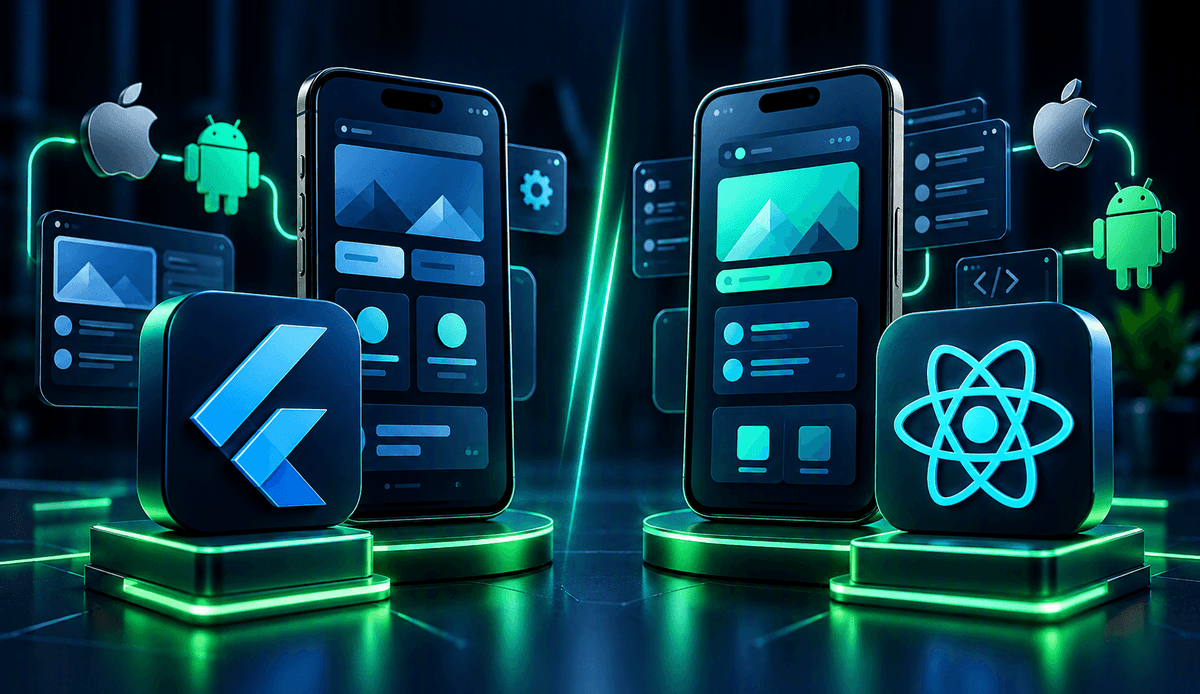
Flutter or React Native? A Comparison for Mobile App Development

 10.26.2026

Choosing the right technology when developing a mobile application affects the project's performance, development process, and maintenance costs. Flutter and React Native are two popular options that enable developers to build applications for multiple platforms using a single codebase. So, which one is better suited to different types of projects?
What Is Flutter?
Flutter is an open-source user interface (UI) development toolkit developed by Google. It enables developers to build applications for multiple platforms using the Dart programming language. Flutter supports application development for Android, iOS, web, and desktop platforms.
In Flutter, user interfaces are built using components called widgets. Text, buttons, menus, and page layouts can all be created using these building blocks. Since Flutter renders interfaces using its own graphics engine, it makes it easier to maintain a consistent design across different platforms.
Flutter's key features include:
- Single codebase: Shared code can be used across multiple platforms.
- Hot reload: Code changes can be viewed quickly while preserving the application's current state.
- Customizable interfaces: Developers can create animations and custom UI components.
- Broad platform support: In addition to mobile applications, Flutter can be used to build web and desktop applications.
Flutter can be a good option for projects where design consistency and highly customizable interfaces are important.
What Is React Native?
React Native is an open-source framework that brings the React approach to mobile application development. It enables developers to build Android and iOS applications using JavaScript or TypeScript. Developers with React experience can apply their existing knowledge to mobile projects.
React Native provides components such as View, Text, and Image for building user interfaces. These components correspond to native UI structures on the target platforms. As a result, applications can take advantage of native Android and iOS components.
React Native's key features include:
- JavaScript and TypeScript support: Web development experience can be applied to mobile projects.
- Native UI components: Developers can work with components based on each platform's native interface structures.
- Code sharing: Shared code can be used across Android and iOS applications.
- A mature ecosystem: Tools such as Expo and a wide range of libraries support the development process.
React Native can be a suitable option for companies with existing React teams and projects that aim to create synergies between web and mobile development.
What Are the Differences Between Flutter and React Native?
Flutter and React Native address similar needs, but they differ in their programming languages, UI rendering approaches, and development ecosystems. Understanding these differences makes it easier to choose the technology that best fits a project's requirements.
| Comparison Criteria | Flutter | React Native |
|---|---|---|
| Developer | Meta and the open-source community | |
| Programming language | Dart | JavaScript or TypeScript |
| UI approach | Flutter's widget system and graphics engine | Native platform components |
| Code sharing | Shared code across multiple platforms | Shared code between Android and iOS |
| Design | Customizable and consistent interfaces | Leverages native UI components |
| Web development experience | Requires knowledge of Dart and Flutter | React and JavaScript experience is an advantage |
| Platform support | Mobile, web, and desktop | Primarily Android and iOS, with additional solutions for other targets |
| Development tools | Flutter SDK, Dart, and IDEs | React Native, JavaScript/TypeScript, and tools such as Expo |
Both technologies support cross-platform development. However, using shared code does not mean that all code will run on every platform without modifications. Platform-specific adjustments may be necessary for certain features.
Which Is More Performant: Flutter or React Native?
Application performance depends not only on the chosen technology but also on the application's architecture, the operations it performs, and the libraries it uses. Therefore, it would not be accurate to say that Flutter or React Native is faster in every project.
Flutter can be a strong option for graphics-intensive applications and applications with custom designs, thanks to its ability to compile to native machine code and render interfaces using its own graphics engine.
React Native, on the other hand, uses native UI components. With its modern architecture, native code integration options, and suitable libraries, it can deliver a smooth user experience in many applications.
The decision should be based on the application's actual requirements. Factors such as animation complexity, large data lists, access to device features, and startup time can be tested using a small prototype. This allows teams to evaluate real-world performance rather than relying solely on general comparisons.
Which Projects Should Use Flutter?
Flutter can be a good choice for teams that want to deliver a consistent user experience across different platforms and maintain detailed control over their interfaces. It can be particularly beneficial for projects where visual design is an important part of the product.
Examples of projects that may be suitable for Flutter include:
- Android and iOS applications that require a consistent design.
- Applications featuring animations and custom graphical components.
- Projects that plan to develop web or desktop versions alongside a mobile application.
- Projects involving teams willing to learn Dart and work with the Flutter ecosystem.
For example, an event application that needs to maintain the same design language across multiple platforms could be developed with Flutter. The team can use a shared widget structure to make the appearance of different screens more consistent.
Which Projects Should Use React Native?
React Native can make it easier for developers with JavaScript or TypeScript experience to transition into mobile application development. It can be particularly suitable for teams that want to reuse their React expertise and share some business logic with existing React projects.
Examples of projects where React Native may be a good fit include:
- Mobile applications developed by existing React teams.
- Products that require a shared codebase for Android and iOS.
- Projects where knowledge sharing between web and mobile development teams is important.
- Applications that can benefit from Expo and libraries within the React Native ecosystem.
For example, an e-commerce platform operating on the web may consider React Native when developing a mobile application. Experience with React and TypeScript can provide a head start during development. However, the web interface should not be expected to transfer directly to the mobile application.
Is Flutter or React Native Difficult to Learn?
The learning curve for both technologies depends on the developer's previous experience. For beginners, learning the framework alone is not enough. They also need to understand fundamental programming concepts such as variables, functions, data structures, and application architecture.
Dart is the primary language used with Flutter. Developers who already know JavaScript or TypeScript may find React Native more familiar. On the other hand, those willing to learn a different language and focus on UI development may prefer Flutter.
For both technologies, building small projects is a useful way to learn. You can start with a list application, then build a screen that fetches data from an API, and finally create a simple project that includes user authentication. These exercises help developers understand how the tools work and gain practical development experience.
Should You Choose Flutter or React Native?
When choosing between Flutter and React Native, you should consider the programming language, team experience, UI requirements, and target platforms together. Flutter may be the better choice when customizable interfaces and broad platform support are priorities. React Native may be more suitable when you want to leverage existing React experience and work with native UI components.
Both technologies can be used to build successful mobile applications. The best choice should be based on the project's requirements and the team's technical expertise rather than popularity alone.