Kanban vs. Scrum: Which Methodology Should Be Chosen and When?

 10.26.2026

Kanban and Scrum are agile project management approaches that help teams organize their work, improve collaboration, and achieve their goals. So, what are the differences between Kanban and Scrum? In this article, you will explore the features and advantages of both approaches, as well as the types of projects for which each may be suitable.
What Is Kanban?
Kanban is a work management approach that focuses on visualizing workflows and keeping work in progress under control. Its main goal is to make it clear which tasks team members are working on, identify bottlenecks, and ensure that work flows more smoothly.
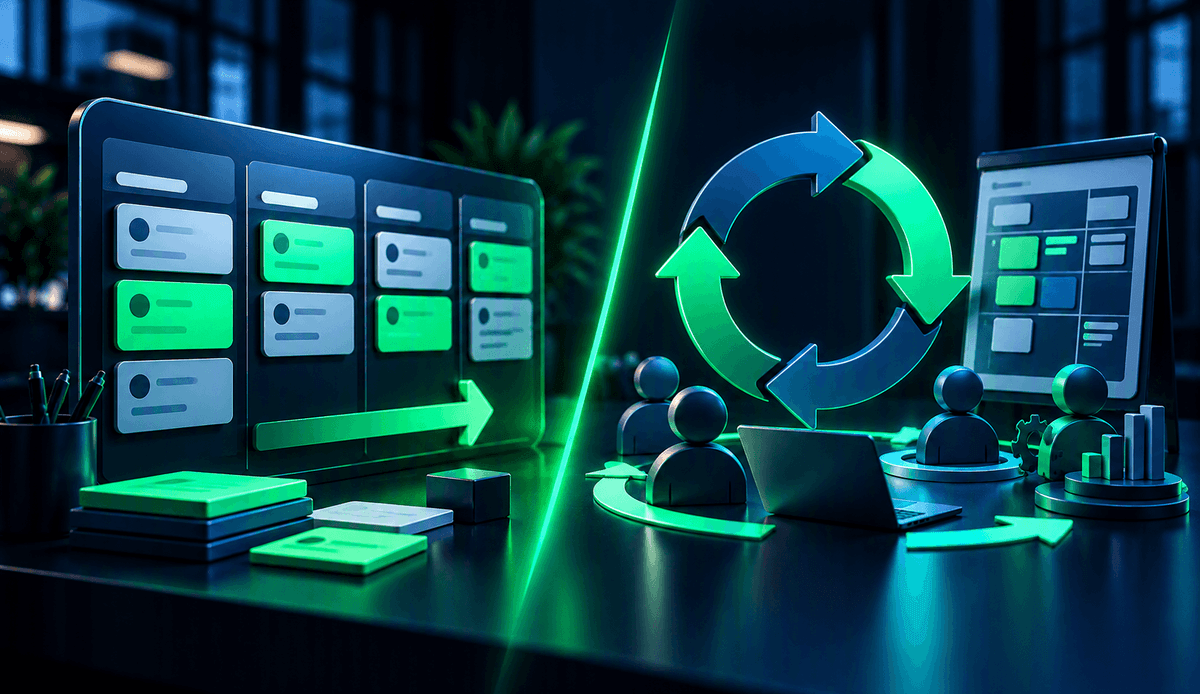
In Kanban, tasks are typically represented by cards on a board. Each card represents a specific task or work item. Cards move between columns according to the current status of the work.
For example, a software team might organize its Kanban board using the following columns:
- To Do: Tasks that have not yet been started.
- In Progress: Tasks currently being worked on.
- Code Review: The stage where completed code is reviewed.
- Testing: The stage where the software is validated.
- Done: Completed tasks.
One of Kanban's key features is the ability to limit the amount of work in progress. This helps teams focus on completing existing tasks instead of starting too many tasks at once. Since Kanban does not require fixed-length work cycles, it can also be used by teams that handle a continuous flow of incoming work.
What Is Scrum?
Scrum is a framework used to facilitate the development of complex products. It is built around defined accountabilities, events, and work cycles. It helps teams work toward a shared goal, receive regular feedback, and adjust their plans based on changing needs.
In Scrum, work is generally carried out in fixed-length periods called Sprints, which last one month or less. Each Sprint has a specific goal, and the team focuses on the work selected to achieve that goal.
The main components of Scrum are:
- Product Owner: Responsible for maximizing product value and ensuring effective management of the Product Backlog.
- Scrum Master: Supports the understanding and effective implementation of Scrum.
- Developers: Team members who work together to create a usable product increment during each Sprint.
- Sprint Planning: An event where the Sprint Goal and the work to be completed are planned.
- Daily Scrum: A daily event where Developers inspect progress toward the Sprint Goal and plan their work.
- Sprint Review: An event at the end of the Sprint where the resulting product increment is reviewed with stakeholders.
- Sprint Retrospective: An event where the team evaluates its way of working and identifies opportunities for improvement.
Scrum can be a suitable option for product development teams that need regular planning, feedback, and evaluation cycles.
What Are the Differences Between Kanban and Scrum?
Both Kanban and Scrum aim to improve work visibility and help teams operate more effectively. However, they differ in how work is planned, how progress is tracked, and how teams manage their workflows.
| Comparison Criteria | Kanban | Scrum |
|---|---|---|
| Workflow | Continuous flow of work | Fixed-length Sprints |
| Planning | Can be performed continuously as needed | Planning takes place at the beginning of each Sprint |
| Work priorities | Can be updated according to workflow needs | Guided by the Sprint Goal and existing commitments |
| Roles | No mandatory predefined roles | Includes the Product Owner, Scrum Master, and Developers |
| Meetings and events | No mandatory set of specific events | Includes defined Scrum events |
| Workload management | Limits the amount of work in progress | Considers Sprint scope and team capacity |
| Progress tracking | Monitors workflow, completed work items, and bottlenecks | Evaluates the Sprint Goal, product increments, and feedback |
| Approach to change | Work can be reprioritized within the workflow | Scope can be clarified or renegotiated without jeopardizing the Sprint Goal |
These differences do not mean that one approach is always better than the other. The right choice depends on the team's working style, how predictable the work is, and the needs of the project.
When Should You Choose Kanban?
Kanban can be beneficial in environments where work arrives continuously and priorities change frequently. If a team needs to work with an uninterrupted flow rather than fixed Sprint periods, Kanban may be worth considering.
In particular, tasks in maintenance, support, and operational processes can arise at different times. In these environments, it can be important to bring work into the workflow without waiting for the next Sprint.
Kanban may be suitable for the following situations:
- Managing software maintenance and bug fixes.
- Tracking customer support requests.
- Planning content production and marketing tasks.
- Managing operational activities and recurring requests.
- Making workflows more visible in teams where priorities change frequently.
For example, a software support team may receive various bug reports and user requests throughout the day. A Kanban board can show which tasks are waiting and which have been completed. Setting limits on work in progress can also help prevent the team from starting too many tasks simultaneously.
When Should You Choose Scrum?
Scrum can be suitable for teams that want to plan at regular intervals and evaluate results while working toward a specific product goal. Particularly when developing complex products, short work cycles allow teams to test assumptions and incorporate feedback into subsequent work.
Scrum may be a good choice in the following situations:
- Developing a new software product or application.
- Shaping product features based on user feedback.
- Regularly evaluating different stages of product development.
- Working toward a shared Sprint Goal.
- Improving a product through regular reviews and continuous improvement.
For example, a team developing a new mobile application might focus on user registration during its first Sprint and profile management during the next. At the end of each Sprint, the resulting product increment can be evaluated, and the next steps can be planned. This allows the team to develop the product incrementally rather than working for an extended period without receiving feedback.
What Are the Advantages of Kanban and Scrum?
Both approaches support greater work visibility, better team communication, and process improvement. However, their benefits differ depending on how they organize work.
Advantages of Kanban:
- Makes it easier to monitor workflows through a single board.
- Encourages focus by limiting the amount of work in progress.
- Helps identify bottlenecks and see where tasks are getting stuck.
- Enables gradual process improvements without requiring major changes to existing workflows.
Advantages of Scrum:
- Helps the team focus on a shared and measurable Sprint Goal.
- Provides regular opportunities for feedback and evaluation.
- Establishes planning and review practices throughout product development.
- Helps clarify accountabilities and working practices within the team.
For either approach to be effective, simply using the tools or holding the meetings is not enough. Teams need to evaluate their working methods regularly and incorporate what they learn into their processes.
Which Is Better: Kanban or Scrum?
When choosing between Kanban and Scrum, it is important to recognize that no single approach is the best option for every team. The frequency of incoming work, the pace at which priorities change, team structure, and delivery expectations should all be considered.
If work arrives continuously and priorities change throughout the day, Kanban may be more suitable. If product development requires working toward specific goals, conducting regular reviews, and incorporating feedback through structured cycles, Scrum may be a better fit.
It is also possible to use both approaches together. For example, a team working in Sprints can benefit from a Kanban board and work-in-progress limits. In such implementations, workflow visibility can be improved while preserving Scrum's fundamental rules.
The key is to build a working system that meets the team's actual needs rather than choosing a methodology simply because it is popular.
Kanban and Scrum offer different but complementary approaches to managing work. Kanban emphasizes continuous workflow and reducing bottlenecks, while Scrum focuses on Sprint Goals and regular feedback. The right choice should be based on the project's needs and the team's working style.