NVIDIA Opens a New Chapter in Robotics!

 16.07.2026
Artificial intelligence has undergone a remarkable transformation over the past few years. It began with conversational AI, followed by image and video generation models that quickly became part of everyday life. Today, the industry's focus is shifting toward systems that bring AI into the physical world.
One of the most significant developments in this space is NVIDIA's Jetson Thor platform. The company says its new platform has been developed specifically for humanoid robots and advanced autonomous systems. Its goal is to enable robots to perceive their surroundings, run AI models locally, and perform physical tasks more efficiently.
What Is Jetson Thor?
Jetson Thor is NVIDIA's next-generation AI computing platform designed for robotics applications.
Built on NVIDIA's Blackwell GPU architecture, the platform is engineered to handle demanding workloads such as generative AI, computer vision, sensor data processing, and robot control within a single system.
According to NVIDIA, Jetson Thor delivers:
- Up to 2,070 FP4 TFLOPS of AI computing performance
- Support for up to 128 GB of unified memory
- Configurable power profiles ranging from 40 to 130 watts
NVIDIA also states that Jetson Thor offers significantly higher AI performance and improved energy efficiency compared with the previous-generation Jetson AGX Orin platform. These comparisons are based on NVIDIA's own internal measurements.
Why Is AI Moving Into Robotics?
Until recently, artificial intelligence was primarily associated with digital applications. However, as robots become increasingly common across manufacturing, logistics, healthcare, and service industries, the demand for more capable AI systems has grown rapidly.
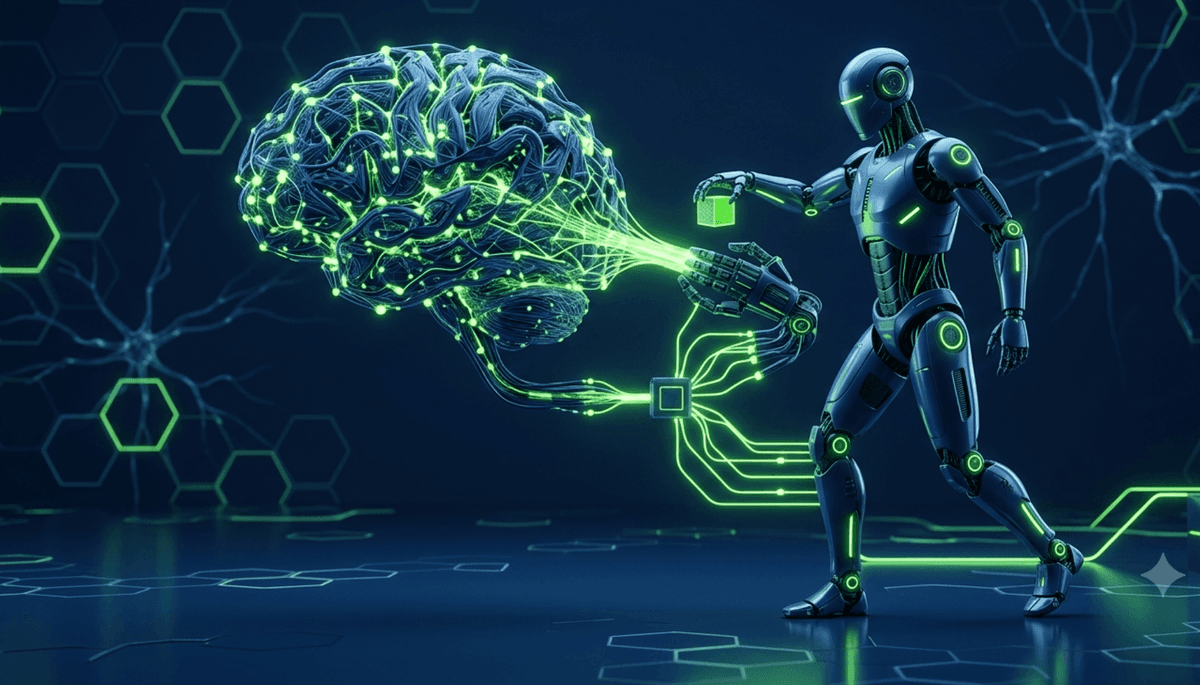
This evolution is reflected in NVIDIA's concept of Physical AI.
Unlike traditional AI systems that generate text or answer questions, Physical AI refers to intelligent systems capable of interpreting sensor and camera data, understanding their environment, and carrying out real-world physical tasks.
Jetson Thor has been developed as one of the key platforms supporting this vision.
Competition in Robotics Is Accelerating
Humanoid robotics has become one of the fastest-growing areas of investment in the technology industry.
While companies such as Tesla, Figure AI, Boston Dynamics, Agility Robotics, and Unitree Robotics are developing humanoid robots for a variety of applications, NVIDIA positions itself as a provider of the underlying AI computing infrastructure.
In addition to the Jetson platform, the company offers a comprehensive robotics ecosystem through technologies such as CUDA, JetPack, and NVIDIA Isaac, giving developers access to both hardware and software tools for building next-generation robotic systems.
Why Does It Matter for Türkiye?
Interest in robotics and industrial automation continues to grow across Türkiye, particularly in the automotive, defense, manufacturing, and logistics sectors.
Engineers, research teams, and technology companies are closely following global AI platforms as they develop next-generation robotics solutions.
Jetson Thor is expected to become one of the platforms attracting attention from developers working on computer vision, autonomous systems, and advanced robotics projects.
A New Era in the AI Race
The competition in artificial intelligence is no longer limited to large language models.
Technology companies are increasingly investing in robotic systems capable of bringing AI into the physical world.
In this environment, high-performance computing, low latency, and energy efficiency have become critical factors for enabling robots to make decisions in real time.
Jetson Thor is one of NVIDIA's latest platforms developed to address these challenges.
As artificial intelligence continues to evolve, robotics is emerging as one of its most important application areas.
NVIDIA's Jetson Thor represents a key part of the company's Physical AI strategy, providing a powerful computing platform for next-generation robotic systems. How significant its long-term impact will be depends on how developers and