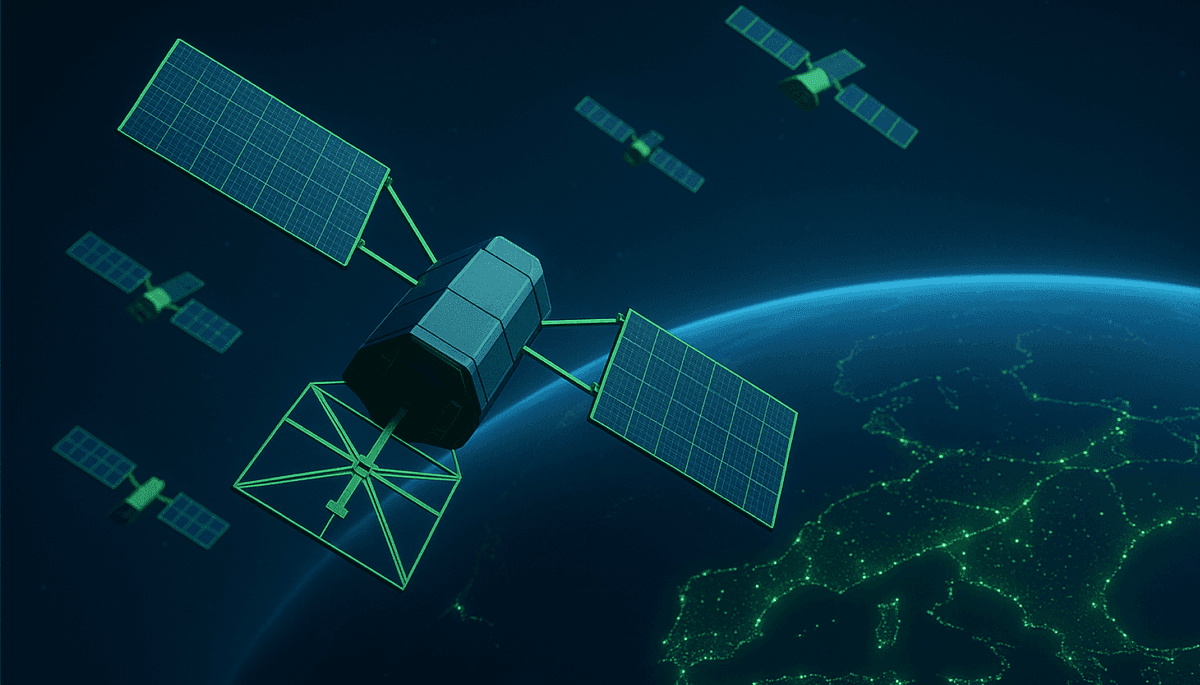
What are Starlink Satellites and What are their Functions?

 11.01.2025
What Are Starlink Satellites and What Do They Do?
Starlink is a revolutionary project that provides internet access from space.
In this article, you’ll learn what Starlink satellites are, how they work, where they are used, and how they could transform the future of global internet infrastructure.
What Is Starlink?
Starlink is a satellite internet network developed by SpaceX, founded by Elon Musk.
Its main goal is to deliver high-speed internet access even to the most remote areas of the world.
The system operates through thousands of small satellites that work together in orbit to transmit data.
Compared to traditional satellite internet, it stands out with much lower latency.
How Does Starlink Work?
The working principle of Starlink is highly innovative.
The system consists of small satellites moving in low Earth orbit (about 550 km above the surface). These satellites send signals to users on Earth through an antenna.
Here’s a simplified overview of the process:
- The user connects to the satellite network through an antenna called the Starlink Dish.
- The satellite receives the internet signal from ground stations.
- The signal is transmitted between satellites and then delivered to the nearest user.
In this way, the internet connection is established without the need for land-based infrastructure — offering high speeds even in regions without fiber networks.
Features of Starlink Satellites
Starlink satellites are smaller and faster than traditional ones, allowing thousands to operate in orbit simultaneously.
Key features include:
- Each satellite weighs about 260 kg.
- Powered by solar panels for self-sufficiency.
- Equipped with automatic collision avoidance systems.
- Uses laser communication technology for data transfer.
- Has an orbital lifespan of about 5 years, after which it re-enters the atmosphere and safely disintegrates.
This structure provides both sustainability and network security advantages.
What Is Starlink Used For?
While Starlink’s main purpose is to provide global internet access, its use cases extend far beyond individual users.
Prominent applications include:
- Rural and remote areas: Provides fast internet where no infrastructure exists.
- Maritime and aviation sectors: Ensures continuous connectivity for ships and aircraft.
- Emergency situations: Enables communication when infrastructure collapses after disasters like earthquakes or floods.
- Military and research fields: Offers secure and independent communication networks.
These versatile applications show that Starlink is not just an internet service — it’s a revolution in communication infrastructure.
Advantages of Starlink
Starlink offers clear advantages in both speed and accessibility, aiming to democratize internet access — particularly in developing regions.
Main benefits include:
- Low latency (around 20–40 ms)
- Global coverage
- Easy installation (only a dish and modem required)
- Independence from fiber networks
- Reliable communication during natural disasters
These features make it especially valuable for users in remote or underserved locations.
Does Starlink Have Any Disadvantages?
Like any emerging technology, Starlink also faces certain limitations.
Severe weather conditions and relatively high costs can impact user experience.
Key disadvantages include:
- High initial installation cost
- Signal weakening during heavy rain or snow
- Light pollution caused by visible satellites at night
- Performance drops when network congestion occurs
These factors show that the system is still in a development and expansion phase.
Is Starlink Available in Turkey?
Starlink is already active in many countries.
As for Turkey, there has not yet been an official launch. However, SpaceX plans to complete its Starlink licensing process in Turkey by 2024.
Once active, it’s expected to become a valuable alternative internet option — especially for users in rural areas.
How Could Starlink Shape the Future?
Starlink is more than just an internet project — it represents the future of global communication infrastructure.
As the number of satellites increases, faster, more inclusive, and lower-cost internet connections will become possible.
Additionally, when combined with 5G and AI-powered technologies, Starlink aims to enable seamless connectivity among IoT (Internet of Things) devices worldwide.
Starlink satellites are redefining global internet access.
Their ability to deliver high speeds without fiber infrastructure makes them one of the most promising technologies of the future.
In the coming years, this system is expected to expand further and potentially become the new global standard for internet connectivity.