Emerging Professions in the Age of Artificial Intelligence!

 18.02.2026
The careers of the future are being created quietly
A few years ago, whenever artificial intelligence was mentioned, most people asked the same question: “Will AI take our jobs?”
Today, the question has changed: “What will our new jobs look like?”
Because the reality is this — AI is not destroying the job market. It is redesigning it. And this transformation is happening much faster than we think.
In this article, we’ll explore the new professions emerging in the AI era, the global trends shaping them, and what this shift means for countries like Turkey — and beyond.
Why Is AI Creating New Jobs?
Artificial intelligence is extremely good at producing output. It can write, code, analyze, summarize, and generate ideas. But it cannot take responsibility.
It cannot truly understand context.
It cannot assess long-term risk or ethical consequences.
That’s where humans come in.
The new economic model is built on a simple structure: The machine produces — the human manages.
This is why companies are increasingly looking not just for developers, but for AI managers.
New Job Categories: Not the Coders, but the Orchestrators
1) AI Operations Managers
Companies no longer use a single AI tool.
They use multiple AI agents working simultaneously:
- customer support bots
- sales assistants
- reporting systems
- content generators
A new role has emerged to manage them: AI Operations Specialist
These professionals may not build the systems themselves. Instead, they:
- assign tasks to AI systems
- monitor performance
- correct errors
- optimize cost and efficiency
Think of them as digital team leaders — managing virtual employees instead of human ones.
2) The New Masters of Content
AI has made content production faster and cheaper. But it has also made quality control more complex.
Today, writing the content is not the most valuable skill. Designing the right output is.
New roles include:
- AI Content Editor
- Prompt Designer
- Brand Voice Manager
- Virtual Character Strategist
The modern copywriter is no longer the person who writes the text — it’s the person who knows how to make AI write it well.
3) Hybrid Professions: Humans Working on Behalf of AI
Interestingly, AI cannot exist in the physical world.
It cannot attend meetings in person.
It cannot inspect a warehouse.
It cannot represent itself in physical operations.
This creates new hybrid roles such as:
- AI field representatives
- remote meeting delegates
- robotics operation assistants
In some cases, job descriptions may literally become: “Physical representative of an AI system.”
4) Trust and Ethics Specialists
As AI systems become more integrated into business, the biggest issue is no longer efficiency — it’s trust.
A single incorrect AI-generated output can damage a company’s reputation instantly.
That is why demand is rising for:
- AI auditors
- ethics specialists
- data bias analysts
- decision validation experts
One of the fastest-growing future career paths will likely sit at the intersection of technology and law.
Where Is the World Heading?
Global research shows a consistent pattern:
- Around half of current job tasks will change
- Most professions will not disappear entirely
- But their structure will evolve
For example: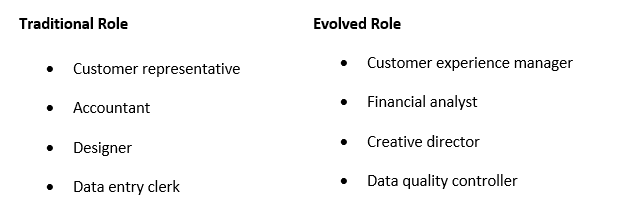
Jobs are not vanishing — they are leveling up.
What Does This Mean for Emerging Markets?
Countries with young populations and strong digital adoption rates may experience this transition differently.
Strengths often include:
- fast technology adoption
- entrepreneurial mindset
- freelance and remote work culture
Challenges may include:
- outdated education systems
- task-based work structures
- limited AI literacy in traditional sectors
In many economies, what will disappear are not entire professions — but repetitive, low-value tasks.
The winners will be those who enhance their expertise with AI tools.
Who Will Thrive in the AI Era?
Degrees alone will not define success.
Learning agility will.
The most valuable skills of the next decade will be:
- asking the right questions
- designing intelligent workflows
- evaluating outputs critically
- building human–machine collaboration
In short:
The future belongs not to those who do the work — but to those who design and direct the systems that do.
Artificial intelligence is not just a technological revolution. It is a business model revolution.
The change may not feel dramatic day to day. But it is continuous and structural. One day, we may look back and realize that our job titles have changed completely — even if our core expertise remained the same.
And perhaps the defining profession of the next decade will be this:
Not “a person working with AI,”
but “a person who makes AI work.”