How to Train AI Models: Building an AI Brain

 10.24.2025
Every day, we interact with smartphones, social media algorithms, and AI-powered tools. But have you ever wondered how these AI models actually learn? How do we teach a machine to “think”? 🤔
1. The Foundation: The Power of Data
At the core of every artificial intelligence model lies data. Just as a child learns from their environment, an AI model learns from examples.
Examples of such data include:
- Text (books, articles, social media posts)
- Images (photos, labeled objects)
- Audio (speech, music)
- Numerical data (finance, healthcare, manufacturing, etc.)
The success of a model is directly proportional to the quality and quantity of the data it learns from.
In short: “Garbage in, garbage out.”
2. Model Selection: Which Architecture Will Learn?
AI uses different “brain architectures” for different tasks.
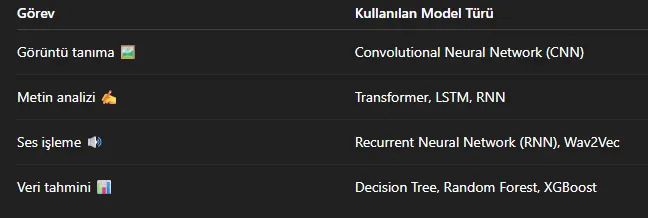
Each model has its own strengths and weaknesses.
An engineer first defines the problem and then chooses the most suitable model to solve it.
3. The Learning Phase: Training
This is where the magic begins! ✨
The model tries to discover patterns among millions of examples.
Some key concepts used in this process include:
- Epoch: One full pass over the entire dataset.
- Loss Function: Measures how much error the model makes.
- Optimizer: Updates model weights to reduce error (e.g., Adam, SGD).
- Learning Rate: Determines how fast the model learns (too high and it “memorizes,” too low and it “fails to learn”).
With every iteration, the model learns from its mistakes… just like a human, but millions of times faster.
4. Validation and Testing
We’ve trained the model — but has it really learned, or just memorized?
To find out, we split the data into three parts:
- Training set: For learning.
- Validation set: To monitor the learning process.
- Test set: To measure real performance.
If the model performs well on the test data, it’s ready for the real world.
5. Fine-Tuning: Customizing Intelligence
Large language models (like GPT or Claude) are trained on massive datasets,
but later fine-tuned for specific tasks.
For example:
- A customer support bot can be fine-tuned with dialogue data.
- A financial analysis model can use sector-specific reports.
- A Turkish grammar correction model can learn from Turkish-only texts.
Through fine-tuning, the model evolves from general intelligence to specialized expertise.
6. Ethics and Safety
AI models must be trained not only technically but also ethically.
This includes anonymizing data, reducing biases, and ensuring supervised training.
Because AI is not neutral… it’s only as unbiased as the data it learns from.
AI Learns, But We Teach
An AI model is, in fact, a reflection of human intelligence.
As we teach it how to think, it teaches us the limits and possibilities of learning itself.
Training AI isn’t just about uploading knowledge into a machine… It’s about redefining what it means to be intelligent.